Auctions | January 29, 2021
Courtesy of Cowan's

An archive of materials mostly related to abolitionist George H. Hoyt's work as an attorney for John Brown. Estimate: $4,000-6,000

Cincinnati, Ohio – Cowan’s, a Hindman company, will present its first dedicated various owner African Americana sale on February 18. The sale will feature a diverse selection of books, manuscripts, newspapers, photographs, posters and ephemera dating from the 18th century through the mid-20th century, representing themes such as slavery and abolition, militaria, civil rights, politics, art, literature and more. A number of influential figures including Frederick Douglass, Booker T. Washington, Martin Luther King, Jr., Marcus Garvey, Madam C.J. Walker, Huey Newton, Eldridge Cleaver and Angela Davis will be represented in the auction.

The sale includes recorded speeches, press photographs, posters, books, a pennant, illustrated (comic) books and more documenting Dr. King and his various campaigns, most notably the marches from Selma to Montgomery, Ala., and the March on Washington for Jobs and Freedom.

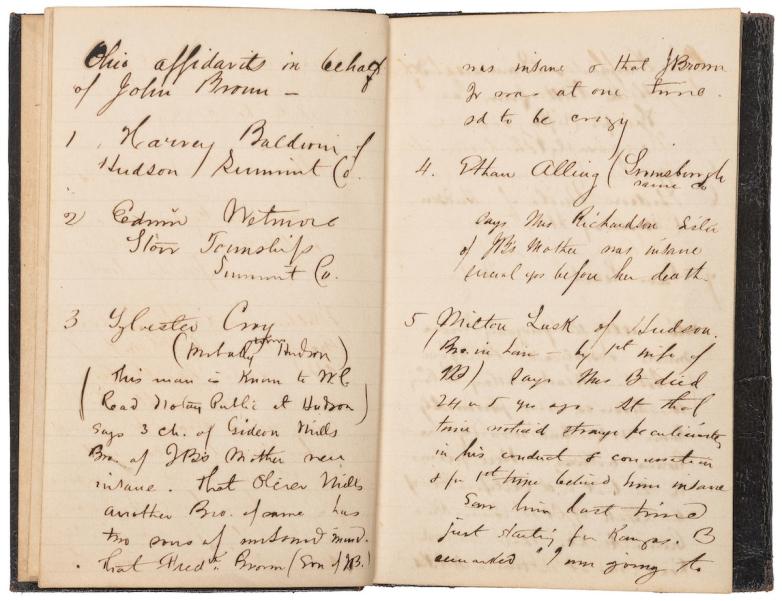
Highlights of the sale include a photograph of Dr. King locking arms with his aides while leading the march to the Montgomery, Ala. courthouse (lot 191; estimate is $1,000-2,000). Another noteworthy piece is a sixth plate daguerreotype of Joseph Jenkins Roberts, the first and third president of Liberia (lot 82; estimate is $10,000-15,000). The archive of Lieutenant Colonel George Henry Hoyt is another standout item (lot 46; estimate is $4,000-6,000). Hoyt most notably acted as one of John Brown's attorneys when the martyred abolitionist stood trial for the raid at Harper's Ferry, Va. Included in the archive are a journal with Hoyt's hand-recorded testimonies from Brown's relatives, former neighbors and old acquaintances, and a scrapbook containing newspaper clippings reporting on Hoyt and the trial. Other notable items include a Black Panther carved rally stick (lot 230; estimate is $300-500), and a quarter plate tintype of two young girls, one African American and one white (lot 84; estimate is $800-1,200).

Marcus Garvey, founder and first President-General of the Universal Negro Improvement Association and African Communities League, is featured prominently in the sale. Signed letters, a broadside, and objects from his Black Star Line are featured in the 14 lots identified to Garvey. Madam C.J. Walker, the first female self-made millionaire in the United States, is also represented through five lots associated with her line of cosmetics and hair care products.

Bidding for the February 18 auction will begin at 10:00 am ET. Bidders will be able to participate via absentee bid, by phone, or live online on Cowan’s website. Previews for the auction will be available at Cowan’s facilities by appointment only. For more information about the auction, please view the auction page and the catalogue.

Book Fairs | January 29, 2021
Courtesy of the Antiquarian Booksellers' Association

London — The Antiquarian Booksellers’ Association (ABA) is pleased to unveil an expansion of their ‘Firsts’ fair brand to include three upcoming online rare books fairs, in partnership with international organisations the Association of Antiquarian Booksellers of Canada (ABAC/ALAC) and the Associazione Librai Antiquari d'Italia (ALAI). Following the success of its three online rare book fairs in 2020, the ABA is working with its Canadian and Italian counterparts to bring a series of three online rare books fairs under the names ‘Firsts Canada’, ‘Firsts Italia’ and ‘Firsts Online Winter Edition’.

Launching the online rare book fair calendar is ‘Firsts Canada’ taking place from 5-7 February 2021 and featuring exclusively ABAC/ALAC or ILAB members. The fourth instalment of the ABA’s online fair, Firsts Online Winter Edition, will occur from 18-23 February 2021 featuring ABA and ILAB members. New for this edition, the ABA is offering complimentary registration for its booksellers as part of an ongoing effort to showcase its membership and encourage wider participation. The final online fair to take place will be ‘Firsts Italia’ from 18-21 March 2021 featuring ALAI and ILAB exhibitors.

The ABA’s ‘Firsts Online’ platform was developed in 2020 in order to fill a need for ABA and ILAB booksellers to continue to trade during the pandemic and continue to reach international audiences while physical bookfairs were paused. The Firsts Online platform has been improved and further developed to now offer a more refined experience for exhibitors and visitors alike. Working with their fair partner Biblio, the ABA is confident that the ‘Firsts Online’ model can offer other antiquarian bookseller associations the opportunity to showcase their memberships on a reoccurring basis in 2021.

Details

Fair: Firsts Canada

Dates: 5-7 February 2021

Website: www.firstscanada.com Organisers:

Association of Antiquarian Booksellers of Canada (ABAC/ALAC)

Fair: Firsts Online Winter Edition

Dates: 18-23 February 2021

Website: www.firsts-online.com

Organisers: Antiquarian Booksellers’ Association (ABA)

Fair: Firsts Italia

Dates: 18-21 March 2021

Website: www.firstsitalia.com

Organisers: Associazione Librai Antiquari d'Italia (ALAI)

Auctions | January 28, 2021
Courtesy of RR Auction

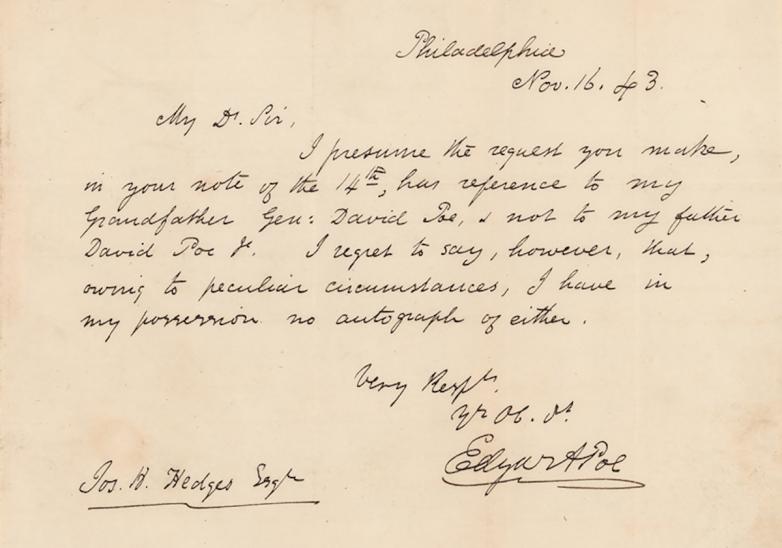
Boston — A remarkable Edgar Allan Poe letter to an autograph collector will be auctioned by Boston-based RR Auction.

The remarkable one-page handwritten letter signed "Edgar A. Poe," dated November 16, 1843. Letter to Joseph H. Hedges, in full: "I presume the request you make, in your note of the 14th, has reference to my grandfather Gen: David Poe, & not to my father David Poe Jr. I regret to say, however, that, owing to peculiar circumstances, I have in my possession no autograph of either."

The recipient, Joseph H. Hedges (ca. 1828-1905), was an early collector of autographs in Philadelphia, clearly seeking the signature of the author's ancestor: either David Poe, Sr., a quartermaster during the American Revolution, or David Poe, Jr., a little-known stage actor. Poe ponders the possibility of both, concluding that his grandfather—who contributed his personal wealth to the patriot cause, earning the esteem of the Marquis de Lafayette and the honorary title of 'General'—would have been more well known to the public.

The "peculiar circumstances" of Poe's upbringing resulted in his having none of their papers. His father, David Poe, Jr., abandoned the family when Edgar was an infant, and died shortly thereafter. His mother, Elizabeth Arnold Hopkins Poe, died just before he turned three, and the three Poe children were split up into three separate households. Young Edgar, taken in by John and Frances Allan (and christened with their surname as his middle name), would have had little in the way of family heirlooms.

By the time he penned this letter, Poe, then a magazine editor living in Philadelphia, had already written some of his best-known horror and mystery tales, including 'The Fall of the House of Usher,' 'The Masque of the Red Death,' and 'The Pit and the Pendulum'; in the same year, he wrote his timeless cryptological classic, 'The Gold Bug.' (Estimate: $75,000+)

"This is a stunning example of an autograph letter by America's master of the macabre," said Bobby Livingston, Executive VP at RR Auction.

The sale also features multiple Einstein letters with significant content on science and religion. Among them is a significant scientific letter documenting an early and critical stage of Einstein's re-evaluation of the ether concept. Einstein here gives a substantive account of "the state of the ether question." After first giving a brief historical overview of the ether, Einstein then considers its relationship to, and implications for, Relativity Theory: "The special theory of relativity is based on the knowledge that there can be no question of such a state of motion [of the ether]," Einstein here affirms. "If one wants to speak of ether as 'carrying' the electromagnetic phenomena, then this carrier has to be something completely different from what we otherwise call 'body', because one cannot speak of 'movement' with it. Under these circumstances it seems better to drop the whole concept and to speak more of electromagnetic and gravitational fields, but not to regard these as states of something else." Einstein forcefully concludes that "only these [gravitational and electromagnetic] fields appear in the laws [of physics]"—tersely pointing at General Relativity as the necessary intellectual context in which the ether question is to be resolved.

Unpublished and unknown to scholarship, the present letter is a valuable and important addition to our knowledge of Einstein's evolving view of the ether. Written at an early stage of Einstein's re-evaluation of the ether concept—before any of his formal public statements on the 'new ether'—the contents of this letter decidedly presage Einstein's first public announcement of his views in 1920. Historians of science are now finding their way to this 'ethereal' aspect of Einstein's thought—Ludwig Kostro's Einstein and the Ether is the key text in the field—and the present letter is a newly discovered document of critical importance to the historical record. (Estimate: $50,000+)

And an Isaac Newton Handwritten Manuscript on Religion. The important handwritten one-page religious manuscript by Isaac Newton, undated. Newton weighs in on a central tenet of Christianity, researching the origin of the doctrine of the trinity, writing in full: "The Council of Nice in decreeing the son to be ὁμοούσιος consubstantial to the father, understood that the father & son were two substances. For so the word ὁμοούσιος implies. But Hosius who (a - Athanas) published the Nicene Creed translated it unius substantiæ, & this translation gave occasion to some of the Latins to take the father & son for one single substance, & to the Greeks of this opinion to translate unius substantiæ by μιᾶς οὐσίας and μιᾶς ὑποστάσεως & to the western bishops in the Council of Serdica to declare that μίαν εἶναι ὑπόστασιν ῆν ἀντὸι ἀιρετικὸι οὐσίαν προσαγορεύουσιν, τοῦ πατρὸς καὶ τοῦ υἱοῦ καὶ τοῦ ἁγίου πνεύματος, that there is but one hypostasis of the father & son & holy Ghost."

This significant autograph statement illuminates the core of Newton's religious heresy. Newton held a view of the Trinity at variance with the Church of England—a heretical view punishable by death—and he here articulates the basis for his theological perspective. The document superbly testifies to Newton's critical mind and philosophic acumen; its use of Greek writing is uncommon. A central document for our understanding of Newton's view of God. (Estimate: $25,000+)

The Fine Autograph and Artifacts sale by RR Auction began on January 22 and will conclude on February 10. For more information, go to www.rrauction.com.

Events | January 28, 2021
Courtesy of the Boston Athenæum

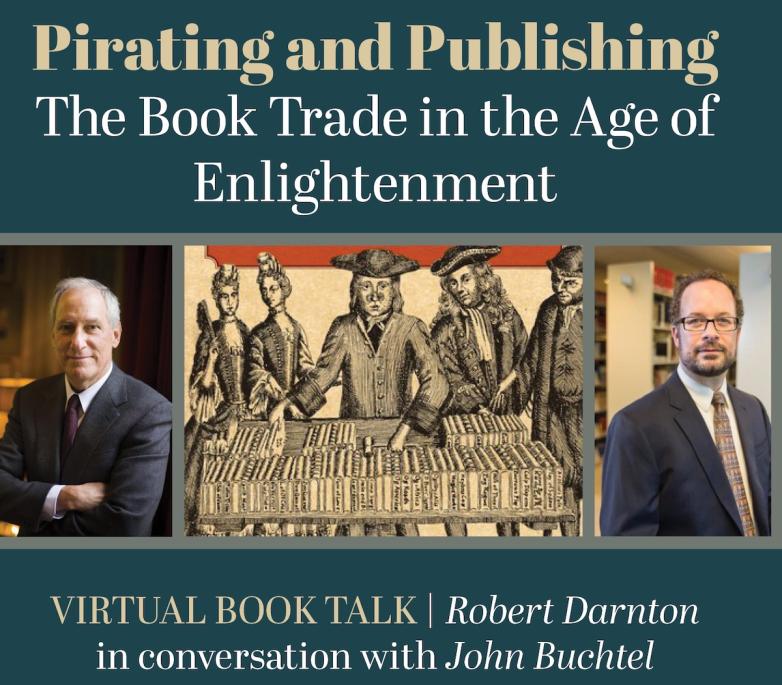
Boston — Reserve a space now for a virtual Book Talk: Pirating and Publishing: The Book Trade in the Age of Enlightenment: Robert Darnton in conversation with John Buchtel. Wednesday, February 3, 2021 - 6:00pm to 7:00pm. Registration is requested. Members and VESP holders: Free | Visitors: $5

In the late-18th century, a group of publishers in what historian Robert Darnton calls the "Fertile Crescent" countries located along the French border, stretching from Holland to Switzerland pirated the works of prominent (and often banned) French writers and distributed them in France, where laws governing piracy were in flux and any notion of "copyright" very much in its infancy. Piracy was entirely legal and everyone acknowledged tacitly or openly that these pirated editions of works by Rousseau, Voltaire, and Diderot, among other luminaries, supplied a growing readership within France, one whose needs could not be met by the monopolistic and tightly controlled Paris Guild.

Darnton's book focuses principally on a publisher in Switzerland, one of the largest and whose archives are the most complete. Through the lens of this concern, he offers a sweeping view of the world of writing, publishing, and especially bookselling in pre-Revolutionary France--a vibrantly detailed inside look at a cut-throat industry that was struggling to keep up with the times and, if possible, make a profit off them. Featuring a fascinating cast of characters lofty idealists and down-and-dirty opportunists this new book expands upon on Darnton's celebrated work on book-publishing in France, most recently found in Literary Tour de France. Pirating and Publishing reveals how and why piracy brought the Enlightenment to every corner of France, feeding the ideas that would explode into revolution.

Robert Darnton is Carl H. Pforzheimer University Professor and University Librarian, Emeritus of Harvard University, and the author of The Great Cat Massacre (1984) and A Literary Tour de France (2018), among others.

John Buchtel is Curator of Rare Books and Head of Special Collections at the Boston Athenæum. He previously served as director of the Booth Family Center for Special Collections at Georgetown University and as curator of rare books in the Sheridan Libraries at The Johns Hopkins University. He earned his Ph.D. in English, with a focus on early modern British literature, at the University of Virginia, while also acting as curator of the teaching collections at Rare Book School. He teaches, lectures, and publishes on the history of books and printing, the history of libraries, book collecting, and literary patronage.

News | January 27, 2021
Credit: The Huntington Library, Art Museum, and Botanical Gardens

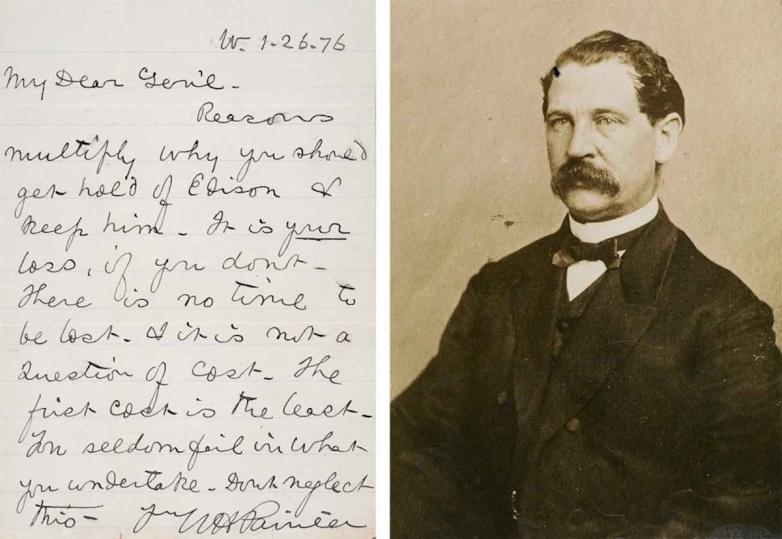
Left: “…get hold of Edison & keep him,” urged a promoter of Thomas Edison’s quadruplex telegraph to Thomas Eckert, president of the Atlantic and Pacific Telegraph Co., in 1876. Thomas T. Eckert Papers. Right: Thomas T. Eckert, circa 1862.


San Marino, California — In a move that deepens its collections in the history of science and technology as well as its American Civil War holdings, The Huntington Library, Art Museum, and Botanical Gardens has acquired the personal papers of Thomas T. Eckert (1825–1910), head of the United States Military Telegraph (USMT) under Pres. Abraham Lincoln and later the president of Western Union. The archive includes materials related to inventor Thomas Edison’s first great electrical invention: the quadruplex telegraph, which allowed users to send four telegraph messages simultaneously. Original documents detail the drama and machinations that unfolded in the early days of telecommunication, when rival railroad barons vied for control of the lucrative telegraph business.

The archive also contains new information that highlights the USMT’s role in the 1862 campaigns of the Civil War, especially those in Virginia and Maryland, including the battle of Antietam.

This is The Huntington’s second acquisition of Eckert’s papers: In 2012, the institution made headlines with its purchase of the official telegraph ledgers of the USMT office in Washington that was headed by Eckert. The ledgers, spanning the years 1862–67, recorded nearly 16,000 Civil War telegrams, including exchanges between Lincoln, members of his cabinet, and officers of the Union Army. Roughly one-third of the messages were written in code. The 2012 acquisition also included the cipher books used for encrypting and decoding telegrams. (A crowdsourcing project was launched in 2016 to transcribe the coded telegrams. The digitized ledgers and accompanying transcripts can be viewed on the Huntington Digital Library. Full decryption of the encoded telegrams is a future project.)

The newly acquired papers comprise Eckert’s own personal files: correspondence from his early Civil War work (Eckert was in charge of all telegraphic communications for Gen. George B. McClellan’s Army of the Potomac from February to September 1862) as well as a previously unknown archive from his post-war career. The collection includes 217 items—letters, telegrams, photographs, receipts, and other materials—that trace the growth, economics, and politics of the U.S. telegraph network as it spread across the nation with the railroads.

A key historical figure in the collection is Union Pacific railroad magnate Jay Gould, who employed Eckert in the 1870s to head his Atlantic and Pacific Telegraph Co. (and who, coincidentally, was a colleague of Collis Huntington, uncle of The Huntington’s founder, Henry Edwards Huntington). Gould’s bitter rival, William Henry Vanderbilt, controlled Western Union, and the archive sheds light on the telegraph wars between the two. Gould ultimately gained a controlling interest in Western Union in 1881; Eckert worked for both men at different times and served as president of Western Union from 1893 to 1900.

“As society has come to rely increasingly on electronic communications, especially during the pandemic, this collection seems particularly relevant,” said Sandra Ludig Brooke, Avery Director of the Library. “This acquisition has great research potential, and it dovetails beautifully with the Library’s existing holdings, particularly in American technology and business enterprise.”

Daniel Lewis, Dibner Senior Curator for the History of Science and Technology at The Huntington, noted that the Thomas Edison materials in this newly acquired collection are particularly significant in the history of telecommunications. “As a young inventor, Edison had telegraphic interests that aligned neatly with his ideas on electricity and electrical transmission,” Lewis said. “In 1874, Edison developed the quadruplex telegraph—his greatest telegraphic invention. It’s hard to overstate the importance of the quadruplex. It allowed four messages to be transmitted simultaneously over the same wire. This was like going from dial-up to broadband in the telegraphic age.”

The papers reveal the behind-the-scenes machinations and struggles for control over the new technology. Given its game-changing importance, the question of ownership of the quadruplex was a critical one. Edison, who had incurred substantial debts from his other undertakings, at first hoped to sell the rights to Western Union, which was controlled at that time by industrialist W. H. Vanderbilt.

“But Western Union tried to lowball Edison, so he offered the quadruplex instead to Jay Gould, who owned the Atlantic and Pacific Telegraph Co.,” said Lewis. “The financier wanted to dominate both the railroad and telegraph business, and he’d bought up a number of companies in both fields. Getting hold of the quadruplex would pose a major threat to Western Union, which was simultaneously one of his archrivals and potential partners.”

Edison did end up selling the quadruplex to Gould, who paid him in cash and stock—a total of $10,000. This led to a squabble between Gould and Western Union, which thought it had already secured the rights. Gould then reneged on paying Edison, who sued Gould. The battle raged on for years in court. Gould ultimately prevailed over his rival by taking over control of Western Union, and Edison was finally paid for his invention.

In addition to the Edison documents, the archive includes Civil War materials that touch on military engagements during the Virginia and Maryland campaigns of 1862. Correspondence between field operators, supervisors, and the War Dept. underscore the challenges that surrounded a commercial communications service under the government contract in war time and provide valuable documentation of the work of telegraph operators and cipher men, many of whom risked their lives sending messages from the front lines. A poignant record notes the death of D. Brainard Lathrop, the first telegraphist killed in action.

“The telegraph really proved its value as a tactical and strategic communication medium during the Civil War,” said Olga Tsapina, The Huntington’s Norris Curator of American Historical Manuscripts. She cites as an example a telegram dated June 16, 1862, containing a request for a telegraph operator to work with aeronaut Thaddeus Lowe, who was conducting operations involving enemy surveillance via hot air balloon.

Many day-to-day details of telegraphic work are documented: construction and maintenance of telegraph lines; recruitment and assignment of operators; military logistics and supply lines; and the USMT operators’ relationship with the high-level military officers in command. In addition, the archive highlights the often contentious relationship between the USMT’s civilian operators and the military Signal Corps. The USMT was established in 1861 as a Western Union affiliate, an expressly civilian service that reported directly to the Secretary of War and the President—despite several attempts by the Army Signal Corps to subordinate it to the military’s command.

“The USMT handled some 6.5 million messages during the war and built 15,000 miles of telegraph lines,” Tsapina noted. “The Union Army’s use of the telegraph as a key military tool allowed it to coordinate a war effort in ‘real time’ for the first time, which ultimately contributed to the North’s victory.”

The Eckert Papers, which had been in private hands until recently, were purchased through the David Zeidberg Library Acquisition Fund and the Donald Duke Acquisition and Cataloging Endowment. Zeidberg, former Avery Director of the Library at The Huntington, had been instrumental in the 2012 Eckert acquisition.

Research Access to the Eckert Papers

The newly acquired Eckert archive will be available for research after processing and cataloging. The papers acquired in 2012 have been cataloged and digitized, and the online catalog entry includes a link to the digital library. Because of COVID-19 restrictions, the Library’s reading rooms are closed for in-person research.

Auctions | January 26, 2021
Courtesy of Swann Galleries

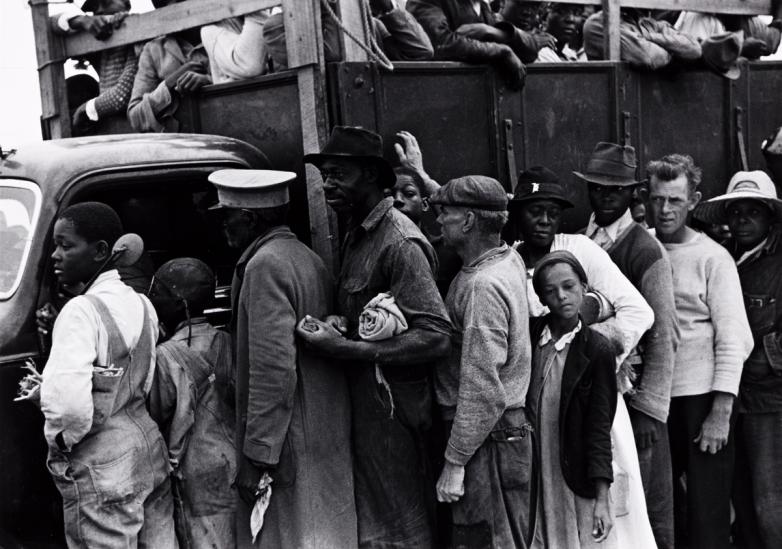
Marion Post Wolcott’s Waiting in a transport line, silver print, 1930s; printed 1980s. Estimate $1,500-2,500

New York — On Thursday, February 4 Swann Galleries will offer the auction: The Artists of the WPA. The multi-departmental sale will feature paintings, prints, photographs, posters, books and related ephemera by artists whose careers were sustained by the Works Progress Administration. In the aftermath of the Great Depression, president Franklin D. Roosevelt’s New Deal and its related agencies represented an unprecedented investment in art and artists, setting the scene for the twentieth century’s art movements, and establishing the careers of diverse creatives, including women, Black artists, photographers, and muralists.

The sale includes a run of works that served as studies and preparations for murals. Highlights include: Louise Emerson Ronnebeck’s Singers, tempera and color pencils, circa 1937, a detail of what would have been the right panel for the mural in the Social Security Building in Washington, D.C. ($5,000-8,000); Edward Millman’s Fresco Detail, St. Louis, MO Post Office, tempera on Masonite, 1942 ($3,000-5,000); a 1937 charcoal and white chalk study Horseless Carriage, Study for Mural for James Daugherty’s mural at the Fairfield Court Housing Project in Stamford, CT ($2,000-3,000); and Dox Thrash’s Trapper with Coon Skin Cap (Ethan Allen Mural Study), tempera, watercolor and ink with pencil, 1939–40 ($2,000-3,000) are also present.

Reginald Marsh’s The Waterfront, New York, a 1943 skyline view ($10,000-15,000), Herbert Kruckman’s 1935 oil-on-canvas The Depression and the New Deal, 1935 ($3,000-5,000), and Leon Bibel’s The Flood, 1939 ($4,000-6,000) are among stand out works in oil. Prints include the 1929 etching Bread Line by Marsh ($5,000-8,000), as well as the lithographs: Comrades, 1943, by Norman Lewis ($5,000-7,000), Lower Manhattan, 1930, by Howard Cook ($5,000-8,000), and Tree Planting Group, 1937, by Grant Wood ($5,000-8,000).       

The Farm Security Administration employed a number of photographers to document the realities of the depression. Included are Dorothea Lange with Sugar beet lifter in older settler's field, which loosens beets and partially lifts them from ground, Near Ontario, Malheur County, Oregon, ferrotyped silver print, 1939 ($4,000-6,000), and Hoe Culture, Alabama Tenant Farmer near Anniston, silver print, 1936 ($4,000-6,000). Walker Evans is present with Country store near Moundville, Alabama, Summer, silver print, 1936, printed 1960s ($6,000-9,000). A select group of 38 vintage silver prints from 1937 to 1942 by John Vachon ($5,000-7,500), and a group of 30 production stills from Pare Lorentz’s 1938 film The River, a documentary film produced by the FSA ($8,000-12,000), make an impression out of the photography offering. Works by Arthur Rothstein, Ben Shahn, Bernice Abbott, and Marion Post Wolcott round out the selection.

Many artists were employed to create posters for the New Deal agencies. Vintage poster examples include a series of three designs by Lester Beall—one of the first designers commissioned by the U.S. government to help promote the Rural Electrification Administration. Beall’s It’s Fine For Us, 1939, A Better Home, 1941 ($10,000-15,000, each), and When I Think Back, 1939 ($8,000-12,000) are present. 1939 New York World’s Fair posters include those by Joseph Binder ($2,000-3,000), Albert Staehle ($800-1,200), and John Atherton ($700-1,000). Additional works of note include a run of Indian Court Federal Building designs by Louis B. Siegriest, images by Katherine Milhouse, and Faith In America / Champions of Democracy promoting democracy.

Limited previewing (by appointment only) will be available through February 3, to be scheduled directly with a specialist in advance and conforming to strict safety guidelines. Swann Galleries staff will prepare condition reports and provide additional photographs of material on request. Advance order bids can be placed with a specialist for the sale or on Swann’s website, and phone bidding will be available. Live online bidding platforms will be the Swann Galleries App, Invaluable, and Live Auctioneers. The complete catalogue and bidding information is available at www.swanngalleries.com and on the Swann Galleries App.

Additional highlights can be found here.

Auctions | January 25, 2021
Courtesy of Nate D. Sanders

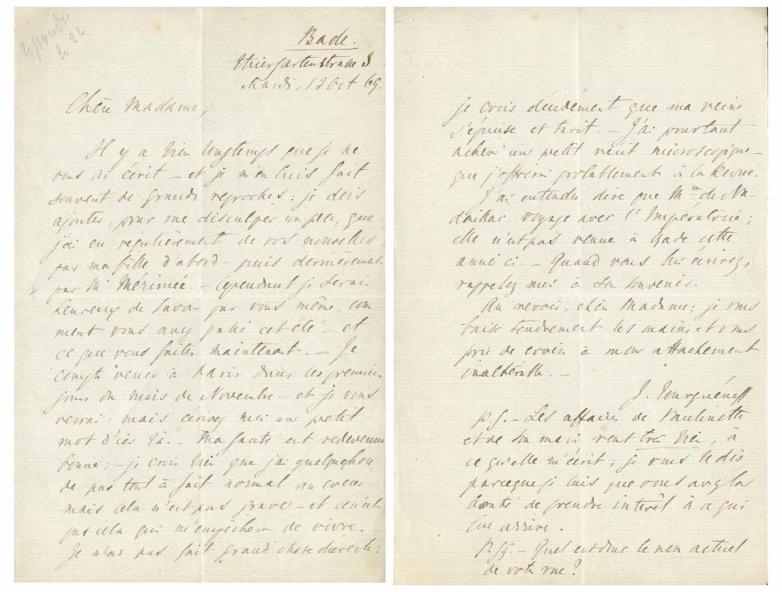
Los Angeles – A letter from 19th Century Russian novelist Ivan Turgenev first  referring to his upcoming short story, likely ''King Lear of the Steppes,’’ will be auctioned by Nate D. Sanders Auctions on January 28, 2021.

Turgenev wrote to French socialite Valentine Delessert on October 12, 1869 from Baden, Germany.

The letter in French reads in part: ''Dear Madam, It has been quite a while since I have written to you - and I have often greatly reproached myself for it; I have to add, to excuse myself somewhat, that I have received news of you regularly, first from my daughter, then later from Mr. Merimee. Nonetheless, I would be happy to hear directly from you how you have been this summer - and what you are doing now. I intend to come to Paris in the first days of November - and I will see you…I definitely think that my productive vein is running out and drying up. I have, however, completed a microscopically small story - which I will probably submit to the Revue…”

Bidding for the book begins at $3,000. Additional information on the book can found at  https://natedsanders.com/19th_Century_Russian_Novelist_Ivan_Turgenev_Autogr-LOT59266.aspx

Auctions | January 25, 2021
Courtesy of Christie's

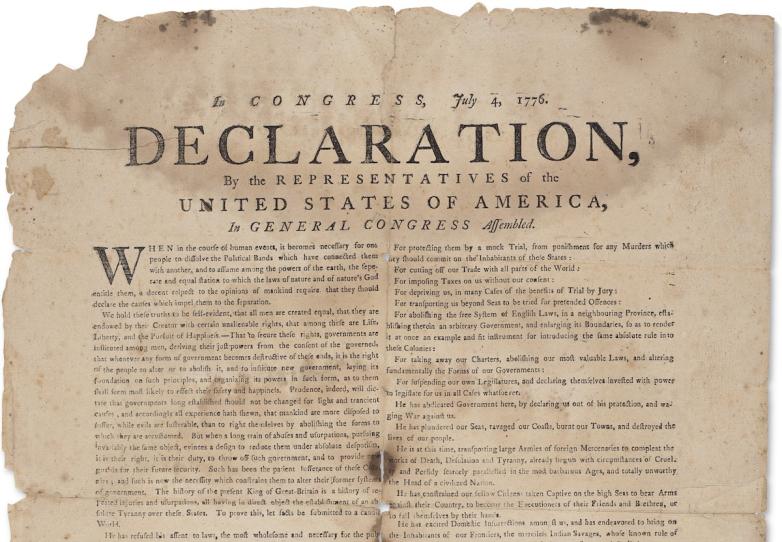
New York — Christie’s week of Americana sales totaled $9,202,500 and established five auction records. A rare contemporary 1776 broadside edition of the Declaration of Independence from the Collection of Ambassador J. William Middendorf II sold for $990,000, achieving the top price across the series of sales.

“What an extraordinary week during extraordinary times,” said John Hays, Deputy Chairman, Christie’s America. “Record prices were paid in every category sold this week—most notably the portrait of George Washington, by James Sharples and a contemporary broadside of the Declaration of Independence. This auction demonstrates the continued strong interest Americans have in their art and culture—from Native American basketry, silver, furniture and Outsider Art. It was an honor for Christie’s to represent the owners of these remarkable pieces offered in the auction.”

In Praise of America: Important American Furniture, Folk Art, Silver, Prints and Broadsides New York | January 21-22

Sale Total: $5,936,000

The sale was led by the rare contemporary 1776 broadside edition of the Declaration of Independence from the Collection of Ambassador J. William Middendorf II which sold for $990,000, above its estimate of $600,000-800,000. Auction records were established for two works from the Middendorf Collection; a fine copy of Paul Revere’s iconic engraving of the Boston Massacre which totaled $412,500, and a portrait of George Washington by James Sharples, which sold for $325,000, exceeding its estimate of $50,000-70,000.

A Newport card table made by John Townsend totaled $250,000 and the selection of silver was led by a set of twelve American 18- karat gold after dinner coffee cups, saucers, and spoons by Tiffany which sold for $110,000. Srong prices were achieved for Folk Art including a Washoe basket by Dat So La Lee sold for $237,500 above its estimate of $40,000-60,000, and a carved white marble recumbent lion from the Siegmund Collection, which totaled $50,000.

Peter Klarnet, Senior Specialist, Americana, Books and Manuscripts, comments: “We were extremely honored for the opportunity to offer highlights from Ambassador Middendorf’s collection – and the sale’s results confirm the continued strong interest in important pieces of printed Americana.”

Outsider and Vernacular Art
New York | January 21

Sale Total: $2,137,750

Christie’s Outsider and Vernacular Art totaled $2,137,750 with 99% sold by value and 97% sold by lot, surpassing over twice the total low estimate. The sale was led by Bill Traylor, Two Dogs Fighting; Man Chasing Dog, 1939-1942, which realized $293,750, more than double its low estimate of $100,000. Additional top lots of the sale include Martín Ramírez, Untitled (Tunnels and Train), 1950s, which achieved $187,500, against a low estimate of $40,000 and Thornton Dial, Creation of Life in the Blackberry Patch, 2003, which realized $150,000, against a low estimate of $40,000. The sale also saw three new artist records for Judith Scott, Raymond Materson and Laura Craig McNellis.

Cara Zimmerman, Head of Sale, Outsider Art, comments: “Phone and internet bidding enabled buyers and bidders from around the globe to set exceptional prices and make the sale a great success. Art institutions, first-time bidders and established collectors all participated; Outsider Art has never had a broader audience.”

Chinese Export Art Featuring Property from the Tibor Collection Online | January 7-20

Sale Total: $1,128,750

The online sale of Chinese Export Art Featuring Property from the Tibor Collection totaled $1,128,750 and sold 99% by value, led by A Rare Pair of Goose Tureens and Covers, which sold for $150,000. Additional top lots of the sale include A Rare Ox-head Tureen and Cover, which achieved $52,500 and A Pair of Famille Rose Roosters, which realized $52,500.

Carleigh Queenth, Head of Sale, Chinese Export Art, comments: “Today’s sale was a testament to the vitality of the Chinese Export market. Porcelain designed by Cornelis Pronk, mugs from the Eckenhoff Collection and fabulous figures from the Tibor Collection all had strong results. The bidding was particularly spirited for a number of birds in the sale, including a pair of famille rose roosters, a rooster tureen cover and a pair of hawk boxes and covers.”

News | January 22, 2021
Courtesy of ILAB

Submissions are open for the prestigious 18th ILAB Breslauer Prize for Bibliography, to be awarded in May 2022 for new bibliographical publications printed between 2018-2021. The prize winner will receive $10,000 and an additional second and third prize of $5,000 and $3,000 will be awarded.

Any aspect of bibliography (enumerative, textual, history of the book, design, binding, the book trade, etc.) is considered and only certain categories are not eligible, notably catalogues of books intended for sale and translations of works appearing in another language.  

Submissions are made by sending a copy of the publication to Fabrizio Govi, ILAB Breslauer Prize for Bibliography Chair, Libreria Govi, via Bononcini 24, I-41124 Modena, Italy. The deadline is December 2021.  

For rules, past submissions and winners see: https://ilabprize.org and to discuss an entry, please contact secretariat@ilab.org.

News | January 21, 2021
Courtesy of the Yale Center for British Art

New Haven, CT — Elisabeth Fairman, Chief Curator of Rare Books and Manuscripts, will retire from the Yale Center for British Art on January 30, 2021, concluding a career that spans nearly four decades. A search for her successor will be forthcoming.

“We congratulate Elisabeth and wish her all the best in retirement,” said Director Courtney J. Martin. “Her dedication to stewarding the Department of Rare Books and Manuscripts, particularly her role in expanding both the breadth and accessibility of the collection, leaves a lasting mark on the Center and its holdings. She will be greatly missed.”

Fairman joined the Center as the Catalogue Librarian in 1982, and later, after expanding her curatorial duties, held the positions of Associate Curator for Rare Books (1991), Curator of Rare Books and Manuscripts (1998), and Senior Curator of Rare Books and Manuscripts (2008). During her tenure, the department’s holdings have grown to encompass approximately 35,000 volumes dating from the fifteenth century to the present, representing a broad range of material relating to the visual arts and cultural life in the United Kingdom and the former British Empire. She was responsible for adding many works to the collection through purchase and gift. Major donations include the archives of artists Leonard Rosomon (1913–2012), Ron King (b. 1932) of Circle Press, and Ken Campbell (b. 1939); illustrated books and wood engravings from the collection of the poet David Burnett (b. 1937); contemporary works from the collection of Driek and Michael Zirinsky; eighteenth- and nineteenth-century children’s books and games from Ellen and the late Arthur Liman, Yale JD 1957; and contemporary designer book bindings from Margaret and Neale Albert, Yale JD 1961.

“My time at the Center has been the best possible experience, start to finish. I couldn’t have asked for better colleagues—especially during this strange year while we’ve all been working remotely,” said Fairman. “I’ve so appreciated the opportunity to acquire some wonderful objects that I hope will be of interest to a wide audience for years to come. I can also say that one of my greatest joys was working with contemporary artists and introducing their work to students and our visitors.”

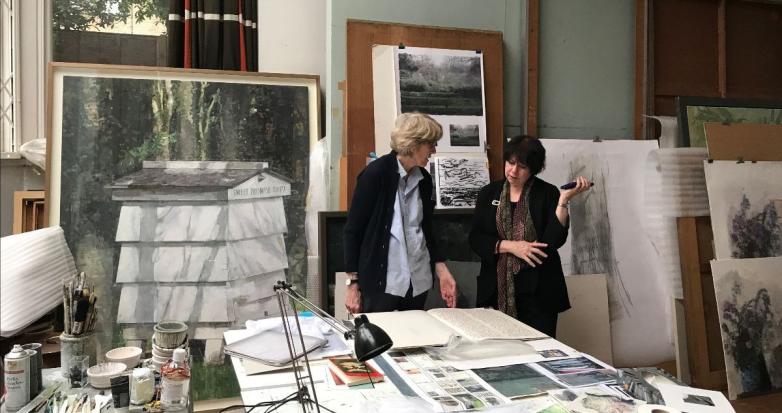
The artist Eileen Hogan, Professor at the University of Arts London and a Trustee of the Royal Drawing School, collaborated with Fairman on three occasions, most recently in 2019. “Through her wide-ranging knowledge and ability to embrace unusual and insightful connections, Elisabeth contextualized my work in unexpected ways and organized, with super-human attention to detail, a huge body of work into a coherent and logical framework,” said Hogan. “Her [building of the] collection is very highly thought of by the UK book art community, practitioners and scholars alike, especially her discernment and ability to understand the artifacts on a human scale and within a social context.”

Fairman supervised the implementation of a robust cataloging program that has allowed access to the department’s collections. She regularly writes and teaches from the collections, assisting students, faculty, scholars, and researchers from all over the world.

“I cannot imagine going to the Study Room and not having Elisabeth there, ready to show me some new and wonderful materials about William Morris, textiles, Indian artisans, or eighteenth-century architecture,” said Professor Edward Cooke, Charles F. Montgomery Professor of American Decorative Arts and Director of Undergraduate Studies in the Department of the History of Art at Yale. “It was like having a personal librarian who knew my interests and happily helped me gather material with which to teach. I will miss her encyclopedic and insightful command of the collection.”

In her time at the Center, Fairman curated over thirty exhibitions on a wide and diverse range of subjects, including the First World War, the natural world, children’s games and pastimes, early maps and atlases, and contemporary artists’ books. Most recently, she was curator of Eileen Hogan: Personal Geographies in 2019; “The Poet of the Them All”: William Shakespeare and Miniature Designer Bindings from the Collection of Neale and Margaret Albert in 2016; and “Of Green Leaf, Bird, and Flower”: Artists’ Books and the Natural World in 2014. These projects were accompanied by significant fully illustrated books with scholarly essays, all published with Yale University Press. In 2014, “Of Green Leaf, Bird, and Flower” was shortlisted for the Author’s Club Book Prize and the Historians of British Art Book Prize.

Fairman received her MSLS from the University of North Carolina at Chapel Hill and her BA from Earlham College. She is a Fellow of the Society of Antiquaries and the Linnean Society, both in London, as well as a Fellow of Davenport College; she is a member of the Print Council of America and the Elizabethan Club of Yale University. She was formerly cochair of the Adrian Van Sinderen Book Collecting Prize, established in 1957 to encourage Yale undergraduates to collect books, and to read for pleasure and education.