Here are the sales I'll be keeping an eye on this week:

Forum Auctions sells Books and Works on Paper on Thursday, August 27, in 209 lots. Sharing the top estimate at £1,500–2,000 are two Hebrew grammatical texts from the 1520s bound together and a volume containing five Shakespeare plays, including the 1730 Dublin edition of the Merry Wives of Windsor). An imperfect copy of Portlock's Voyage Round the World (1789) is estimated at £750–1,000.

At Swann Galleries on Thursday, Vintage Posters, in 353 lots. A 1949 Charles Loupot poster for Lion Noir shoe polish rates the top estimate, at $20,000–30,000. A small-format "Keep Calm and Carry On" poster (1939) could fetch $12,000–18,000. A rare variant of the 1896 Sutro Baths poster is estimated at $10,000–15,000, and a copy of Percy Albert Trompf's 1929 "Australia" poster could sell for $7,000–10,000.

Rounding out Thursday's sales Fine Books with Americana, Travel & Arthur H. Clark Publications at PBA Galleries. The 386 lots include a large collection of publications from the Arthur H. Clark Company from the library of George M. Steinmetz, as well as many Book Club of California and Limited Editions Club publications. Most of the starting bids are in the low three-figure range or below.

On Saturday, Addison & Sarova Auctioneers sell Rare Books, Art & Ephemera at Addison & Sarova on Saturday, August 29. They've got 304 lots on offer this time, with a good mix as usual of early printing, American imprints, manuscript material, and a few large lots of bookplates.

Here’s a fun Video Friday that speaks not only to the services libraries are providing to the community during the pandemic but what they have to do to promote themselves. Meet ‘Curbside Larry,’ aka John Schaffer, a senior library program specialist at the Barbara Bush Branch Library of the Harris County Public Library in Spring, Texas. Don’t miss it:

Yesterday, the High Museum of Art in Atlanta, Georgia, hosted a virtual media preview of its forthcoming in-person exhibition -- the museum recently reopened with a timed ticketing reservation system -- called Picture the Dream: The Story of the Civil Rights Movement through Children's Books. The fifth in a series coordinated with the Eric Carle Museum in Amherst, Massachusetts, this exhibition focuses on crafting children’s books that explore the people and events of the Civil Rights era and is billed as the first of its kind to do so.

“One of the guiding aspects of our mission is a commitment to family audiences,” said the High’s director Rand Suffolk. “Through our children’s book exhibitions, we aim to help adult visitors open meaningful dialogues with the children.” 

In that spirit of openness and a desire to foster important conversations about the Civil Rights Movement, I turned this assignment over to rising sixth-grader Abby Richter, who regularly writes book reviews and interviews authors for Literary Features Syndicate. She sat in on the media preview and filed this report:

Coming soon to a theater near you — if it’s open, that is — is a new film adaptation of Charles Dickens’ novel, David Copperfield, directed by Armando Iannucci and starring Dev Patel as the titular character. The cast also includes Hugh Laurie and Tilda Swinton.

Originally published as a serial beginning in May 1849, David Copperfield is a rags-to-riches story set in Victorian England. Iannucci’s splashy remake debuted abroad last year and won a BAFTA Film Award. The Guardian called it “a surreal cinematic odyssey that is as accessible as it is intelligent and unexpected … It really is a wonderfully entertaining film, managing to both respect and reinvent the novel from which it takes its lead, creating something new and exciting in the process.”  

The Personal History of David Copperfield is slated for American release on August 28. Hopefully, a streaming option will follow for those of us not yet willing or able to venture out into movie theaters. Until then, take a look at this very appealing trailer:

A collection of antiquarian cookery books heads to auction at Bonhams in London tomorrow, almost all with a British bent. It is, after all, a collection built by Ruth Watson, who ran a country house hotel in Suffolk, England, for many years and is now the owner of the newly opened Watson and Walpole restaurant in Framlingham. She is also known for hosting the television programs, The Hotel Inspector and Country House Rescue.

But one American cookbook stands out, not only because of its early date and place of publication — 1830 in Watertown, New York — but because it retains its original, linen-backed, blue-gray paper-over-board binding with a shadowy figure depicted on the back cover. Moreover, no copy has appeared at auction since 1977, according to the auctioneer. The volume is titled The Cook Not Mad, or Rational Cookery, and in it, the anonymous author promotes the use of native ingredients, such as cranberries, corn, turkeys, and watermelon. Their stated aim was “Good republican dishes,” a phrase meant to convey wholesome, no-nonsense food like pickled beef, certainly nothing “English, French, and Italian,” cuisine the author considered “indigestible.”  

The book is estimated to make £500-700 ($650-900).

One of the UK’s finest twentieth-century book illustrators and graphic designers, Barnett Freedman (1901-1958), is being celebrated at the Pallant House Gallery in Chichester, England. Barnett Freedman: Designs for Modern Britain in the first major exhibition of his life and work for sixty years.

Earlier this summer, we posted about a virtual exhibition and catalogue celebrating the 250th anniversary of a journey during which Joseph Banks discovered and documented 1,300 previously unknown botanical species, a project that would in time become the famous Florilegium.

In today’s “double feature,” bookseller Dr. Anke Timmermann of Type & Forme provides more context on Banks’ botanical work during the Endeavour voyage and discusses how he and his associates processed, described, and drew the plants in preparation for the engraving.  
 

Part II explores how two sets of craftsmen worked across two centuries to produce the Florilegium:

Our Bright Young Librarians series continues today with Seth James, Special Collections Manager at Vigo County Public Library in Terre Haute, Indiana.

What is your role at your institution?

I am the Special Collections Manager at Vigo County Public Library in Terre Haute Indiana.

How did you get started in special collections?

I first became seriously interested in Special Collections after college when I started exploring the world of book collecting. I had always collected books to an extreme degree, but my criteria for which books I would collect was purely based on whether I thought a book looked interesting. It wasn’t until I was working as an administrative assistant at a small public library that I really started investigating the world of rare books more closely. Aside from my administrative duties, I was to help sort through books that patrons had donated. One of the Friends of the Library volunteers who also sorted the donated materials was an avid book collector and he began “showing me the ropes” of identifying first edition books. Eventually this friend of mine gave me Bill McBride’s A Pocket Guide to the Identification of First Editions and from there I began digging deeper into identifying and collecting first edition works on my own. At the time I didn’t think I would be able to use this knowledge in any capacity outside of it being my hobby, but my book collector friend encouraged me to look into MLS programs with specialization tracks for Special Collections.

Where did you earn your MLS/advanced degree?

I received an MLS and an MA in history while enrolled in the dual master program at Indiana University, Bloomington. Upon arriving at IU I immediately began enrolling in all the Special Collections courses that I could. During this time I took many courses with Joel Silver while pursuing my MLS degree. Joel’s courses, as well as his willingness to endure my countless questions both in class and out, helped cultivate my growing love for Special Collections. Joel was also kind enough to be my advisor while I was at IU-Bloomington, and his patience and breadth of knowledge was an inspiration to me. I have especially fond memories of taking Joel’s Rare Book Bibliographies class which, in turn, is the cause of my obsession with bibliographies to this day.

In addition to my coursework at IU, I was also fortunate enough to work at the Lilly Library while pursuing my degrees. I first worked as a reading room attendant at the Lilly Library for several semesters, but then was given the opportunity to work as an assistant to the Head of Public Services, Rebecca Bauman. Under Rebecca’s supervision, I learned valuable skills and working knowledge that did much to prepare me for a career in Special Collections. In this job I helped staff members prepare for visiting classes, corresponded with researchers, and, probably most importantly, weekly helped to turn the page of the volume of Audubon’s The Birds of America that was displayed in the Lilly Library’s main exhibition hall. I attribute much of my success as a manager and a supervisor to Rebecca’s guidance and professional advice. I treasure my memories of working with Joel, Rebecca, and everyone else at the Lilly Library. Their enthusiasm for rare books and manuscripts, and passion for guarding and preserving these treasures inspired me then and continues to inspire me now.

Favorite rare book / ephemera that you've handled?

Although working at the Lilly Library allowed me to handle many incredible books and manuscripts, the Lilly Library’s 1543 edition of Andreas Vesalius’s De humani corporis fabrica is always at the top of my list. It was one of the first books I looked through when I started classes at Indiana University, and it was certainly one of the first that made my mouth drop open with awe. It’s a beautiful volume, with such lush and oftentimes bizarre illustrations, and a gorgeous vellum binding. There is so much to love about this book. Besides, I have a soft spot for woodcuts depicting cherubs engaging in dissections.

What do you personally collect?

For some time now I’ve been slowly collecting the Malay Edition works of Joseph Conrad. Although they are not particularly valuable, they’re beautiful books – particularly if one can find them complete with their dust covers. I’ve had limited success in finding them with their dust covers but it’s a work in progress. I also collect books on heraldry and historiography.

What do you like to do outside of work?

I love to hike, read, listen to and play music. Over the course of the COVID-19 pandemic and subsequent shutdowns my spouse and I really threw ourselves into working on my garden. Not to brag, but my tomatoes are looking pretty great this year.

What excites you about special collections librarianship?

One of my favorite aspects of my job now is showing materials from our collection to visitors. I am always happy when our visitors get excited when they see, for instance, a first edition of Their Eyes Were Watching God by Zora Neale Hurston. But I really love it when they open up the book and see Hurston’s signature and it begins to dawn on them that this isn’t just a book – it’s a piece of living, breathing history. This moment wouldn’t happen, of course, if special collections librarians weren’t advocating for the relevance of their collections and institutions in the 21st century. I am encouraged to see special collections professionals advocating for their collections all the more, and showing that special collections has a significant place in the world of academic research and in education. It is also encouraging to see more and more professors, teachers, and members of the wider public start seeing the value in special collections. In addition, I am inspired by seeing special collection institutions embrace digital exhibitions and the digitization of materials for remote access. This shows that our profession can also reach those who, for whatever reason, might not be able to visit our institutions in person. In short, I am excited by how much special collections librarians are adapting to new challenges and showing, without a doubt, that they have much more to offer the people we serve.

Thoughts on the future of special collections librarianship?

Many other people have a better grasp on what might be in store for us as special collections professionals, but, as I mentioned before, I am only seeing more enthusiasm and interest from the public in what we do. I think that in our digitally saturated age, people often do yearn for the comfort of the physical object. That isn’t to say that the digital age hasn’t helped us in significant ways; social media has been an excellent tool for promoting our collections, and our digitized collections have been essential for researchers (especially during COVID-19).

I also believe that public libraries have a significant part to play in the future of special collections. I think it’s essential that special collections institutions show that their collections are relevant outside of the academic context, and public libraries are well-suited to do that. Our institutions preserve these materials for the education, enjoyment, and benefit of all, and I am proud of the unique role that public libraries can play in doing this.

All of which is to say, I think the future for special collections is bright, and I’m honored to be a part of that future.

Any unusual or interesting collection at your library you'd like to draw our attention to?

I am particularly proud of our collection of inscribed Zora Neale Hurston first editions, which are in beautiful condition. We also have a two volume set of Ovid’s Metamorphoses, in Latin and English, from 1724. We also have a 1669 edition of Ogilby’s Homer, which has been a big hit with our visiting classes from Indiana State University. We have many more rare books and manuscript collections worth of note, and I’m very glad that our library can be their home.

Any upcoming exhibitions at your library?

We are currently preparing an exhibition in honor of the 100th anniversary of the passage of the 19th amendment. We will be drawing from our collections to highlight several important figures and organizations that were involved in the Women’s Suffrage movement in Indiana, including activist, author, and Terre Haute resident Ida Husted Harper.

Before we get to the upcoming sales, some notes from last week:

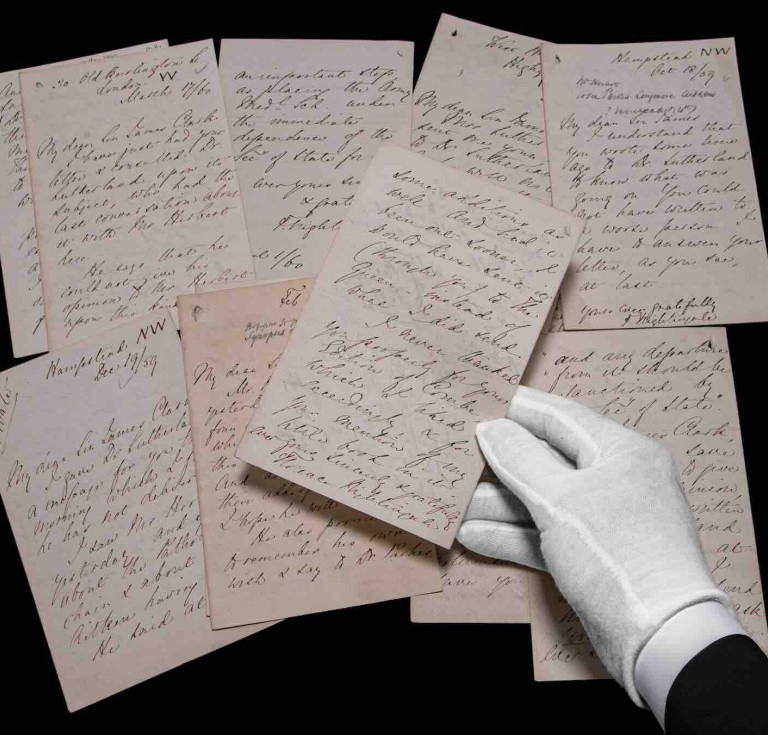
At the Sotheby's Books and Manuscripts: A Summer Miscellany sale, the revised final working typescript of Truman Capote's Breakfast at Tiffany's, used as the setting copy, sold for £378,000, over estimates of £120,000–180,000. But it was an 1829 letter from Mary Anning to William Buckland which vastly exceeded expectations, selling for £100,800 over estimates just just £8,000–12,000! This is believed to be the first Mary Anning letter ever offered at auction.

A quiet week coming up in the salerooms, but with a trio of sales to keep an eye on, all happening Thursday, July 13:

Forum Auctions will sell Books and Works on Paper, in 258 lots. An 1854 Teesdale New General Atlas of the World rates the top estimate, at £1,000–1,500. A three-volume set of William Dampier's Voyages, mounted and heavily marked up in preparation for a new edition in the early nineteenth century, is estimated at £600-800. An album from around 1927 containing fifty pochoir-colored woodcut Sensu fan designs could also fetch £600–800. Papers and various materials from the children's book author Patricia Rubinstein (1915–2003) are estimated at £300–400.

At Swann Galleries, LGTBQ+ Art, Material Culture & History. The 293 lots include a set of photographer Duane Michals' sequence Narcissus (1985), one of 25 copies, estimated at $20,000–30,000. A sketchbook of early works by David Wojnarowicz (1954–1992), could sell for 10,000–15,000. Mark de Solla Price's collection of ephemeral material related to the gay nightlife of New York City in the 1980s is estimated at $5,000–7,5000. An Oscar Wilde note inviting "Ted" (perhaps Theodore Tilton) to dinner during his November 1882 visit to New York City could sell for $3,000–4,000.

Finally, at PBA Galleries, a sale of Publications of the Limited Editions Club, in 368 lots, most being sold without reserve. A huge range of LEC titles, so do have a browse if you're keen on them!

What was Oscar Wilde’s favorite amusement? “Writing sonnets and reading.” Favorite occupation? “Reading my own sonnets.” Aim in life? “Success: fame or even notoriety.”

In 1877, while still a student at Oxford, Wilde penned these revealing responses within the pages of a Mental Photographs album, a bound journal that one would hand around to friends to elicit their “confessions of tastes, habits and convictions.” Alongside his pasted-in carte-de-visite, Wilde answered thirty-nine of the forty questions (apparently he did not wish to share his motto) and signed his full name, Oscar Fingal O'Flahertie Wills Wilde. At auction in London earlier this week, the volume sold for £47,880 (about $62,000).

His favorite poetess? Sappho—and his mother, Lady Wilde. His idea of happiness? “Absolute power over men’s minds, even if accompanied by chronic toothache.”

“Wilde’s responses sparkle with the author’s characteristic ebullience and many are perfect Wildean epigrams. Knowing what we do about Wilde’s sharp wit and lofty world-view, his replies are exactly what one would expect to see from this bold intellectual young writer, still in his early twenties but already experiencing his first taste of fame. This questionnaire — likely filled in for an admiring fan — freezes the young Oscar in a moment in time, but also provides a chilling prophecy of what was to come,” said Sotheby’s director and senior specialist in the department of printed books and manuscripts, Dr. Philip Errington.   

Back in our summer 2016 issue, we took a look at the mid-nineteenth-century Mental Photographs fad and how it evinced the tastes of the day. Even Frederick Engels played the bourgeoisie parlor game, and Mark Twain provided flippant replies when asked to fill one out. "These questions are so arranged as to ferret out the most secret points of a man's nature without his ever noticing what the idea is until it is all done and his 'character' gone for ever,” noted Twain. (Sounds like those ubiquitous questionnaires that circulate on Facebook.)

The album was offered amongst a collection of Wilde first editions from the collection of actor and director Steven Berkoff, a.k.a. General Orlov in 1983’s Bond classic, Octopussy.