Williams College Librarian Anne Peale on Institutional Collecting and George Mason’s Constitution Draft
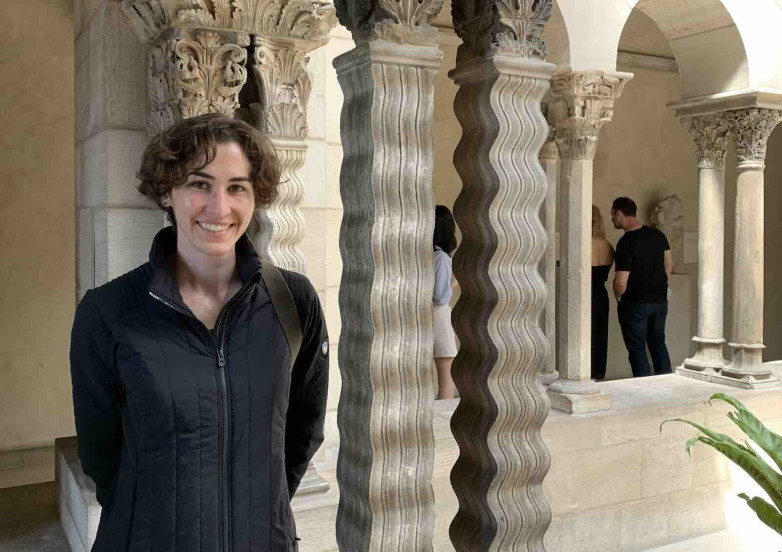
Dr. Anne Peale, Chapin Librarian at Williams College in Massachusetts



Our Bright Young Librarians series continues today with Dr. Anne Peale, Chapin Librarian at Williams College in Massachusetts.
What is your role at your institution?
I’m the Chapin Librarian at Williams College, where I curate our collection of rare books, manuscripts, and other primary sources to support the liberal arts curriculum.
How did you get started in special collections?
I sat in on a special collections session for a course called 'Books as Art' while visiting Dartmouth as a prospective student. Turning the pages of Blaeu’s Atlas maior along with the class was a pretty convincing argument for the power of a liberal arts education. The following year, as a freshman, I signed up for a seminar in book history and then stumbled across the letterpress studio during orientation. After undergraduate jobs in the preservation department, Book Arts Workshop, and special collections, I was lucky to spend a year as a postbaccalaureate fellow at Dartmouth’s Rauner Library, which introduced me to archival processing and public service.
Where did you earn your degrees?
After Dartmouth, I moved to Scotland, where I received a master’s in Material Cultures and the History of the Book and a PhD in Geography from the University of Edinburgh.
Favorite rare book / ephemera that you've handled?
I can never settle on an answer to this question, in part because what I love most about my job is connecting people with collections. That said, I have a soft spot for a Kashmiri birch bark manuscript that first arrived on my desk as a donation from a local family. It had been in storage for several generations and came to us in a tupperware container, carefully wrapped in clingfilm and tinfoil. Coordinating the manuscript’s conservation, digitization, and cataloging was one of my first forays into the wider bibliographic community, and I’m grateful for the time and expertise of everyone who contributed to that work.
There are only a handful of items in the collection at Williams that we aren’t able to allow students to handle, and that manuscript, which turned out to be a Sanskrit grammatical commentary, is one of them. The team at the Northeast Document Conservation Center designed a fabulous box that allows us to display the volume without risking damage to the exceptionally brittle leaves - and everyone is welcome to turn the pages virtually.
What do you personally collect?
Nothing yet, institutional collecting is enough for now!
What do you like to do outside of work?
Rock climbing has been a huge part of my life since graduate school. My friends joked that I earned a master’s in climbing with a concentration in book history. When the weather is good, my husband and I spend most of our weekends at crags all over the Northeast, but my all-time favorite place to climb is still the sea cliffs of northern Scotland. Climbing is a great hobby for disconnecting from work - it’s hard to worry about planning my next class session while using all my physical and mental energy to stay on the wall.
What excites you about special collections librarianship?
Each generation of students brings a new set of curiosities and concerns to the library. As our curriculum evolves, so must our holdings, and it’s a privilege to be one of the people supporting growth into new areas of collecting and teaching. This semester, I’ve brought new acquisitions to courses ranging from Introductory Arabic and the Arts of Tibet to A Nation of Immigrants and Protest Song.
Thoughts on the future of special collections librarianship?
For me, the most meaningful way to help recruit the next generation of special collections librarians, researchers, donors, and collectors has been to continue to expand access and ensure that as many students as possible get to experience what it’s like to work with the Chapin Library’s collections. In addition to the dozens of Williams classes that visit Special Collections each semester, I regularly offer sessions for other area colleges that don’t have special collections of their own.
I also think it’s important to be open to using our collections in new ways. We’ve expanded our curricular offerings for language learning (why not practice your German grammar with a 19th century primer printed in Cincinnati?). We’re also working on new collaborations with students and colleagues at the Williamstown Art Conservation Center, Department of Chemistry, and Williams College Museum of Art to explore technological approaches to the examination of our collections.
Any unusual or interesting collection at your library you'd like to draw our attention to?
In addition to small class sizes, Williams can offer one of the highest incunable-to-student ratios in the country. The collection is more than just high spots, though, and we’re working hard to globalize what has historically been a library strongest in incunabula and Americana. I’d also love to know why 11 tiny glass unicorns were stored in a box of the internal records I’ve been reorganizing lately!
Any upcoming exhibitions at your library?
We use exhibit planning as a student learning opportunity whenever possible. I’m currently working with one of our undergraduate research assistants to co-curate the Chapin’s edition of the semiquincentennial show that so many institutions will be putting on this summer. We’ll include some greatest hits like our Dunlap Broadside and George Mason’s draft copy of the Constitution (on the back of which he penned lengthy frustrations with the document), but we’ll also highlight ephemeral material that documents how less prominent Americans would have received news about the Revolution.
My student co-curator is fascinated by the satirical pamphlets in our early Americana collection - which I knew nothing about prior to his research -so expect to see quite a few of those in the show. And if you visit Williamstown before the end of January, check out my exhibit of assassination-related Garfieldiana, which I’ll be sharing more about at the Ephemera Society of America conference this March.