A Lifetime of Conversations from the Antiquarian Book Trade



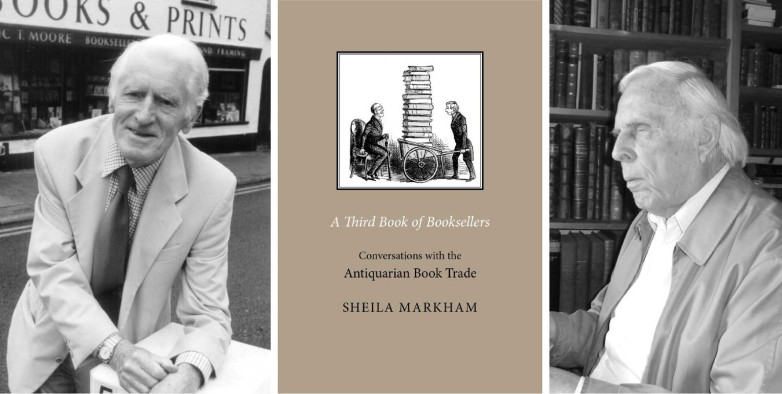
left: Bookseller Eric Moore. middle: A Third Book of Booksellers: Conversations with the Antiquarian Book Trade. right: Bookseller William Poole.
Sheila Markham has reached a new landmark in her ongoing project to interview book dealers and collectors with the publication of A Third Book of Booksellers, out now in a limited edition of 500 copies.
After developing a taste for rare and antiquarian books while a student and serving as the treasurer of the Oxford University Society of Bibliophiles book collecting club, she joined Marlborough Rare Books in London. “It was here that I first met the book dealers and collectors whose passion, eccentricity, expertise, and occasional roguery inspired the idea that perhaps I would one day write about them,” she said.
She later worked with the bookseller and collector Colin Franklin and Christer von der Burg’s Hanshan Tang Books before setting up her own bookselling business in 1991. That year, Barry Shaw, editor of the Bookdealer, invited her to write a series of profiles of antiquarian booksellers. She continued for a decade until the magazine ceased publication in 2010, at which point she had profiled 117 of the industry’s leading lights. In 2011, Nicolas Barker, then editor of The Book Collector magazine, asked her to continue the column, and the series is still ongoing.
The fruits of her labors can be seen on her website (sheila-markham.com), and she has published two previous collections, A Book of Booksellers (2004) and A Second Book of Booksellers (2014). In December 2025, A Third Book of Booksellers is being released with an introduction by Richard Ovenden, the Bodley’s Librarian at the University of Oxford. Browsing the archive, which includes conversations with book collectors along with sellers, is a real pleasure, with several surprising headlines (“Nial and Margaret Devitt: We’ve been very happy in bookselling—whatever Nial may have told you about wanting to run a bordello in Istanbul”) and plenty of familiar faces.
“I soon discovered that my colleagues were an amazingly varied, talented, and often eccentric group of people, whose working lives were also full of interest,” said Markham, who is also the librarian of the Travellers Club in Pall Mall in London. “It became obvious that there are many different ways to sell a book. Several interviewees have told me over the years that you need to be a good storyteller to be a bookseller, and I have tried to reflect this in my published conversations with the trade.”
In 1995, she met Eric Moore, whose business was based in Hertfordshire. “It was a perfect example of the dying breed of provincial secondhand and rare bookshops, and is now a block of flats. Thirty years later, I believe that Eric’s definition of bookselling still holds true, namely ‘the most humane, sociable, ill-organized, yet absorbing form of commerce to be found anywhere’.”
Markham counts meeting William Poole (1935-2021), believed to be the first person to have become a bookseller despite being blind since birth, as the most memorable interviewee. He entered the trade with the help of a loan from the Royal National Institute of Blind People, where he had worked as an editor in Braille publishing.
“With the help of his amanuensis, Patrick Pollard, he developed a respected business specializing in the history of classical scholarship. When I interviewed William in 2013, we talked about Google’s project to create a monumental digital library of the world’s rare books. It was at a time of much talk about the ‘death’ of the printed book, but William was the first of my interviewees to point out the fragility of digitized text. ‘We don’t yet know how long these technologies will last, or how stable they are, compared to what we know about the durability of parchment and paper.’”
A few people have declined to be interviewed. Markham, not a collector herself, is especially sorry about Diana Parikian (1926-2012), one of the first women to work as an antiquarian bookseller in the UK. “She combined joie de vivre and great scholarship and was also an accomplished musician. Her second husband, Manoug Parikian, was a professor of violin at the Royal Academy of Music. She helped him to build an important collection of early Armenian printed books, now in Eton College Library.”
So why are the interviews important to share?
“I like to think that the interviews convey the voice of experience and might be useful alongside more conventional methods of educating young booksellers and inspiring newcomers to enter the trade. As apprenticeships hardly exist these days, and internships are usually only available at a few of the larger firms, I hope that my work will provide those starting out in the rare book trade with a source of useful information and guidance not easily found elsewhere.”