_93845366_355788a1-6606-40a2-978b-bc4d912c6870.jpgOver 350,000 documents related to the Georgian era held in the Royal Archives are scheduled for digitization. Some highlights have already been made available online, including a draft of an abdication letter written by George III at the end of the American Revolution. At the time, the king was in the midst of a wide-ranging political battle, derided around Britain as the "king who lost America." George III strongly considered abdicating the throne to his eldest son and embarking on a self-appointed exile to Hanover. The letter, drafted in 1783, however, was never sent or formalized and George III continued on as king until his death in 1820.


Another highlight is a letter from a spy, codename "Aristarchus," who wrote George III in 1781 regarding an elaborate plan to transfer 4,000,000 French Livres to London. Arisarchus also asks for payment for informing the king of a French plan to assissanate him while he was walking in the Queen's Garden.


Documents and letters from George III's wife, Queen Charlotte, are also part of the archive scheduled for digitization. A highlight already available is a letter from Queen Charlotte to Lady Charlotte Finch, wherein the queen enclosed a lock of Prince Albert's hair.


Highlights from the collection will be featured in an upcoming BBC documentary, "George III: The Genius of the Mad King."


The digitization efforts are part of the Georgian Papers Programme, a five-year, multi-institutional effort to expand access to the collection of Georgian papers held in the Royal Archives and Royal Library at Windsor. 


[Image supplied by the Royal Archives, copyright Her Majesty Queen Elizabeth II 2016]


Love looks not with the eyes ... but we do, which is why a new digital archive of 3,000 illustrations, taken from four different Victorian editions of Shakespeare's Complete Works, is a dazzling resource. The Victorian Illustrated Shakespeare Archive was created by Dr. Michael John Goodman, who single-handedly scanned each image as part of his PhD program at Cardiff University in Wales.

Bianca.jpgAbove: "Bianca and Lucentio" (Act III, The Taming of the Shrew), illustrated by H. C. Selous.

The archive is searchable by illustrator and by play, but Goodman also offers word clouds of thematic search terms (e.g., books, witches, skulls), which reveals the frequency of certain ideas and elements. "The database emphasizes that there really is a 'Shakespeare Universe' where different motifs, ideas, and themes recur," Goodman told Cardiff News.

Macbeth.jpgAbove: Header (Act I, Macbeth), illustrated by John Gilbert.

Goodman isolated each image into a black-and-white downloadable file, but he also makes available the original source page. By design, all of the content is free to use, remix, and share through a Creative Commons license. According to Cardiff News, "This is a new kind of academic resource that will appeal as much to Shakespeare scholars and Victorianists as to artists, makers, and creators."

Hamlet.jpgAbove: "This Same Skull, Sir, Was Yorick's Skull" (Act V, Hamlet), illustrated by Kenny Meadows.

All images courtesy of Michael John Goodman, The Victorian Illustrated Shakespeare Archive.

'Tis the season for award ceremonies, and on Monday the American Library Association (ALA) announced the top books for children and young adults at its Midwinter Meeting, held this year in Atlanta, Georgia. 


Kelly Barnhill received the Newbery Medal (awarded for most outstanding contribution to children's literature) for The Girl Who Drank the Moon, published by Algonquin Young Readers.


012217 ala 109590.jpg

                                                                                                                                                      Three authors were recognized with a Newbery Honor: Ashley Bryan for Freedom Over Me: Eleven Slaves, Their Lives and Dreams Brought to Life (Atheneum Books for Young Readers); Adam Gidwitz for The Inquisitor's Tale: Or, The Three Magical Children and Their Holy Dog (Dutton); and Lauren Wolk for Wolf Hollow (Dutton).


012217 ala 109588.jpg

                                                                                                                                                                 The Caldecott Medal for most distinguished American picture book for children went to Javaka Steptoe for Radiant Child: The Story of Young Artist Jean-Michel Basquiat (Little Brown and Company).


012217 ala 109581.jpg

                                                                                                                                                                   The ALA named four Caldecott Honor Books: Leave Me Alone! written and illustrated by Vera Brosgol (Roaring Brook Press); Freedom in Congo Square, illustrated by R. Gregory Christie (Little Bee Books); Du Iz Tak? written and illustrated by Carson Ellis (Candlewick Press); and They All Saw a Cat, written and illustrated by Brendan Wenzel (Chronicle Books.)


012217 ala 109577.jpg

                                                                                                                                                                  The Coretta Scott King Book Award goes to an African-American author and illustrator for outstanding contribution to children's literature. This year's award recognized March: Book Three by Rep. John Lewis (D-GA) and Andrew Aydin (Top Shelf Productions). Javaka Steptoe also received the Coretta Scott King Illustrator award for Radiant Child.


012217 ala 109509 - Copy.jpg

                                                                                                                                                               Several other prestigious awards were also announced--check out the complete list here. Winning books covered themes of overcoming adversity, breaking through barriers, and making a difference in the world. 

                                                                                                                                                                   Congratulations to all this year's winners! 

                                                                                                                                                                      All images courtesy of ALA.org 

House_of_Mark_Twain.jpgAre you a writer in need of inspiration?  Looking for a quiet place to commune with the ghost of a literary giant? Or just need a break from the kids?


The Mark Twain House & Museum in Hartford, Connecticut, is debuting a new program tonight where you can sign up to spend three uninterrupted hours writing inside Mark Twain's library. You, along with a handful of other writers, will have the library to yourself, outside of regular visiting hours, to drum up your inspiration. 


Twain lived in the lavish Victorian mansion between 1874 and 1903, where he used the library to entertain guests, hold family poetry recitals, and read out loud excerpts from his works. Twain's actual writing, however, was conducted in his favorite place: the billiards room. There, Twain would spread out his manuscripts on the large billiards table while composing such classics as "The Adventures of Tom Sawyer" and "The Adventures of Huckleberry Finn."


Writing in Mark Twain's library for three hours costs $50, but includes the perk of being able to tour the house on your own, after hours.


The idea of writing in Twain's library has quickly found an enthusiastic audience.  At the time of writing this blog post, the program has already sold out through October, 2017.  Keep your eye on this page, however, in case more slots open up.


[Image from Wikipedia]


The Jay I. Kislak Foundation announced this week a major donation to the University of Miami and Miami Dade College. Split between the two institutions is a collection that "includes some of the most important original source materials related to the history of the early Americas," according to a jointly issued press statement.

Screen Shot 2017-01-25 at 12.02.18 PM.pngPedro de Medina, L'Arte del Navegar...  (The Art of Sailing), 1554. First Italian edition of one of the earliest treatises on navigation and the first to provide reliable information on the navigation of American waters. The author discusses the use of basic navigation instruments and explains the use of maps and measurements of the sun and North Star to determine latitude. The book, describing early Spanish voyages of discovery, was widely influential during the 16th  century among mariners of Spain, England, France, Italy and Holland. In addition to its scientific and historic importance, this rare volume is one of the most beautiful books printed in 16th-century Europe. Gift to University of Miami, Courtesy of the Jay I. Kislak Foundation.

The collection was assembled over many decades by 94-year-old collector and philanthropist Jay Kislak, who is well known in the rare book world for his 2004 donation of more than 3,000 rare books, maps, manuscripts and objects to the Library of Congress and for his generous support of the Kislak Center for Special Collections at the University of Pennsylvania. He has also sustained the National Collegiate Book Collecting Contest for several years.

This most recent gift of approximately 2,300 rare books, maps, manuscripts, pre-Columbian artifacts, and related material, with its particular focus on Florida, the Caribbean, exploration, navigation, and the early Americas, finds an ideal home in South Florida. Each school will receive a first edition of the famous 1493 letter of Christopher Columbus, in which his describes the New World, as well as a selection of rare and important items. As a whole, the collection is valued at $30 million. Working together, UM and MDC will collaborate on exhibitions, collections care, and outreach.

Screen Shot 2017-01-25 at 12.03.44 PM.pngColumbus Letter: Printed by Johann Bergmann von Olpe in Basle, Switzerland, 1494, this edition includes the first images of what Columbus believed to be islands in Asia. The first section of the book is an epic poem by Carlo Verardus praising Ferdinand's expulsion of the Moors from Granada in 1492. The second part is Columbus' famous letter, De insulis nuper in Mari Indico, with five woodcuts purporting to be the earliest pictures of the New World. Gift to Miami Dade College, Courtesy of the Jay I. Kislak Foundation.

Said Kislak, "I think this is an ideal partnership. We have the opportunity to combine the special resources of each institution and create exhibitions and programs that will be enjoyed by Miami-Dade residents and the millions of people who visit here from all over the world." He added, "For 500 years, Florida has been a focal point of global exploration and cultural exchange. I'm thrilled that Miami's top two institutions of higher education, along with the Library of Congress, will now be using our collections to reveal the fascinating and important role of our community in world history."


aquila rose.jpgPenn Libraries at the University of Pennsylvania have acquired the only known copy of Benjamin Franklin's first printing piece. The broadside, "The Elegy on the Death of Aquila Rose," was printed by Franklin shortly after his arrival in Philadelphia in 1723. At the time, Franklin was still only a teenager.

                                                                                                                                                 Scholars know of approximately 900 works printed by Franklin. The Aquila Rose broadside was the last major piece to be discovered, making Penn Libraries' acquisition particularly significant.

                                                                                                                                             "Many of these works, especially broadsides and small ephemeral pieces, exist in only one or two copies," said Mitch Fraas, a Penn Libraries' curator, in a press statement. "The Penn Libraries now hold more than a third of his print production, making our collection of Franklin's printing among the most important in the world."

                                                                                                                                            The broadside was written by the printer Samuel Keimer and concerns the recent death of Philadelphia poet and pressman Aquila Rose. This copy, the only known survivor, briefly appeared in the 1820s before disappearing again for almost two hundred years. The broadside was recently discovered by an antiquarian bookseller inside a 19th-century scrapbook (seen below).


Hazard_scrapbook_b copy.jpg


Penn Libraries now owns both the first and last works printed by Franklin.

                                                                                                                                                "As an institution founded by Franklin and dedicated to his passion for the widest possible dissemination of knowledge and the promotion of learning, the Penn Libraries is proud to carry the torch of his legacy, lighting pathways to the future by making Franklin's work open and accessible to the wider world," said Vice Provost and Director of Libraries H. Carton Rogers in a press statement.

                                                                                                                                                    The broadside is on display until February 10, along with the album in which it was found, on the first floor of Van Pelt-Dietrich Library Center. A digitized copy of the broadside is already available online.

                                                                                                                                                  Images courtesy of Penn Libraries

A small but interesting archive of material relating to Alfred Lord Tennyson and Charles Dickens has turned up at London-based Chiswick Auctions, consigned by a distant relation of the Ellis family. The product of that family's long-term association with the two authors, the collection contains correspondence, envelopes, clipped autographs, stereoscopic photographs, a rare program pamphlet (1868) produced for a series of Dickens' "Farewell Readings," and a pencil drawing of 48 Doughty Street by a member of the Tennyson family, inscribed: "Home of Charles Dickens.... from Wilderness Aug 3rd 1870," among other notable pieces.

Lot 85. TENNYSON, Alfred Lord (1809-92) Charles DICKENS (1812-70). Collection, Archive (1) copy.jpgCharles Ellis was a wine merchant with literary aspirations. According to a footnote in The Letters of Alfred Lord Tennyson (1987), where an October 1853 letter from the author to Ellis is recorded, "For many years [Ellis] purveyed wines to Dickens, vastly more knowledgeable and discriminating than Tennyson, but, himself a poet (Richmond and Other Poems, 1845), he seems ... to have presented them to Tennyson, perhaps annually, as a sort of oblation." Indeed another letter from Tennyson, written in 1866, thanks Ellis "for your Christmas gift of choice wines."

Lot 85. TENNYSON, Alfred Lord (1809-92) Charles DICKENS (1812-70). Collection, Archive (3) copy.jpgThe personal and longstanding connection between the correspondents may well be enough to encourage bidders toward the £4,000-6,000 ($5,000-7,400) estimate on Wednesday.

Lot 85. TENNYSON, Alfred Lord (1809-92) Charles DICKENS (1812-70). Collection, Archive (2) copy.jpgImages courtesy of Chiswick Auctions.

No matter how you feel about today's inauguration, take heart and consider the first swearing-in ceremony of America's sixteenth president, Abraham Lincoln. On March 4, 1861, the country was a scant six weeks from entering the Civil War, seven states had already seceded from the Union, and rumors of plots to assassinate Lincoln were already swirling in the air. In addition to taking the helm of an ideologically divided country, Lincoln was the first president to be photographed at his inauguration.                                         

One image that survives the day is a salt-print photograph attributed to Alexander Gardner (1821-1882), a photographer in Mathew Brady's Washington studio who would later earn fame for his photo-documentation of the bloddy battlegrounds of the Civil War. Gardner's image of Lincoln taking the oath of office was made into an engraving published in Frank Leslie's Illustrated Newspaper and circulated throughout the country. The black and white photograph shows Lincoln on the steps of the Capitol, a tall, dark speck standing above a crowd of 25,000 attendees. Scaffolding in the background reveals that the Capitol was still undergoing construction.                                                                                                           

Only three known copies of the photograph remain in existence: one is stored at the Library of Congress, another at the Smithsonian Institution, and a third was recently acquired at auction by Bowdoin College. The image has significant connections to the state of Maine; vice-president Hannibal Hamlin was a native of Paris, Maine, and longtime resident Winslow Homer was also in attendance, whose double-page engraving of the inauguration appeared in Harper's Bazaar (Frank Lee's competitor) later that year. Bowdoin College Museum of Art unveiled its acquisition to the public on January 12 alongside its copy of the Homer engraving.                                                                                                                                                                                                Lincoln-nauguration-photo.jpg                                              

 Inauguration of Abraham Lincoln, March 4, 1861, salt print, by Alexander Gardner, American 1821-1882. Courtesy Bowdoin College Museum of Art.


Lincoln called for unity that day, hoping to keep war at bay. "We are not enemies, but friends. We must not be enemies. Though passion may have strained it must not break our bonds of affection. The mystic chords of memory, stretching from every battlefield and patriot grave to every living heart and hearthstone all over this broad land, will yet swell the chorus of the Union, when again touched, as surely they will be by the better angels of our nature."

Our Bright Young Booksellers series continues today with Leo Cadogan, proprietor of Leo Cadogan Rare Books in London.


IMG-20161231-WA0032 (1).jpgHow did you get started in rare books?


My first sustained encounter with rare books was straight after my final exams at university, when I had a library job that included wiping the dust off rows and rows of seventeenth-century volumes - which I enjoyed doing! I liked looking at the volumes (I was probably not the most efficient cleaner). I really got started with an interview at Quaritch, in 1997, at the end of the summer after university. It was arranged for me by a family friend. I was at that point selling leather jackets in Camden Market in London. I think it gave me an edge in the interview to be able to say that not only did I like books (in common with many other people) but I was used to selling things.


When did you open Leo Cadogan Rare Books and what do you specialize in?


I opened Leo Cadogan Rare Books in late 2007. I specialize in cultural and intellectual history from the Renaissance period up to about 1800. I offer books, manuscripts, prints and ephemera illustrative of the life, studies and interests of people of these times. I always look out for the unusual and passionately want to engage people with these old cultures. Early books have to stand side-by-side at book fairs with items that have a lot more obvious cultural impact (say a first edition in dustwrapper of your favourite novel) and I relish the challenge. I began Leo Cadogan Rare Books working mainly in legal history. Legal history is a subject that, following an MA in Renaissance Studies that I took time out of the book trade to do, I subsequently undertook graduate work in. As a bookseller, showing the life in the dry and scholastic subject of Early Modern law was a good way to begin my business - both because there were institutions collecting it and because the working outlook (finding interest in things that immediately seem culturally foreign to many of us) set me up well. Nowadays I look in several other areas besides law and my material is increasingly visual (although to some extent it has always been).


What do you love about the book trade?


We are so lucky to get to handle the materials we do. It is also a trade where people celebrate when you do something ambitious and one that admires care and the development of expertise. Colleagues are tolerant and generous, with their time, favours, and sometimes their prices. With our customers as well, the trade at its best inhabits a unique, serious but friendly space.


Describe a typical day for you:


An ideal day involves making an early start on cataloguing some interesting items, catching the post and email as they arrive, perhaps in the afternoon getting down to the libraries (particularly London Library, British Library, also Warburg Institute) for research, finishing off descriptions in the evening. But there's plenty else going on - admin, some auctions, travel, book fairs in London, the US, and Europe, and a demanding toddler.


Favorite rare book (or ephemera) that you've handled?


Maybe it's the copy of the first humanist Latin collected works of Aristotle (1496) that, so I discovered, had belonged to a famous Renaissance cardinal, book-collector, and patron of philosophers called Domenico Grimani. Visually and in its contents, this Aristotle is a really impressive book, and this copy had a very appropriate and evocative original ownership which was shown by a large painted armorial. But there was more to find out. Part of Grimani's library had been destroyed in a fire in the seventeenth century but another section was put on the market in Rome in 1546. My copy was part of that latter hoard because it was subsequently acquired, probably in a Roman bookshop in the 1560s by a Croatian/Slovenian theology student in Rome called Antun Vramec. He was later to write an important vernacular chronicle printed in Ljubljana in 1578. What a chance that a book should - randomly - have not one but two important Renaissance owners, both in the city of Rome. Vramec disposed of the copy in the city before he left, for Zagreb; after other owners it ended up in an ecclesiastical library in Rome. By around the end of the seventeenth century the copy acquired a typical Italian vellum library binding, but a section of discolouration on the first page showed how the front cover of an earlier binding had broken. The book sums up to me how much interesting history and archaeology there can be in rare books.


What do you personally collect?


I make little starts to collections. I sometimes buy 'beyond speculatively', things that appeal to me for reasons sometimes not immediately explicable, and where I certainly don't know where they are going to fit, or indeed whether they will stay private possessions or become (or stay) part of the stock. It can be a good exploratory process. Sometimes I find an interesting theme doing this, and I then discover other people are also interested in it - and buying that material can then become a straightforward, and rewarding part of my business. I do also occasionally buy old Spanish prints for my spouse, who is an Early Modern art historian.


What do you like to do outside of work?

Reading, general cultural consumption, consumption of food, travel, family life.


Thoughts on the present state and/or future of the rare book trade?


We're at an interesting time. For different reasons, in the cultural spheres there's an explosion of interest in external engagement - engagement with people outside of academic or professional siloes - and there's also an explosion of interest, in academic worlds and society more widely, in material and visual artefacts, and broadly in 'stuff'. Although it may not be the actual cause of these changes, this is an environment where social media has a strong and positive role to play. The book trade can and does take part vigorously in this broadening world. This is all good, and there is a lot of young interest in the book trade, which is great. On the other hand, I hear concerns about the trading volume - the amount of new cash coming into the book trade as compared to earlier times. I am involved in an interesting new outreach project - I co-organize a new high-end books and arts fair in London in the autumn, called INK (or Inkfair London). Last year was its inaugural, and we had encouraging results. Helping run INK certainly keeps me focused on and inquisitive about the wider environment we are working in.


Any upcoming fairs or catalogues?


I have two little lists that I hope to publish soon. One is on science and medicine, and the other contains ephemeral items from the incunable and post-incunable periods. I am doing the Oakland book fair in February, the New York book fair in March, and straight after New York, am co-exhibiting with other dealers from Britain's Antiquarian Booksellers' Association, at an important antiques fair in London. Looking ahead, I have fairs at London Olympia at the end of May, and two more in London at the end of October/beginning of November (INK and the Chelsea Antiquarian Book Fair). There may be more events, and I have various further plans for catalogues. I am busy!


[Image copyright Claudio Corivetti]



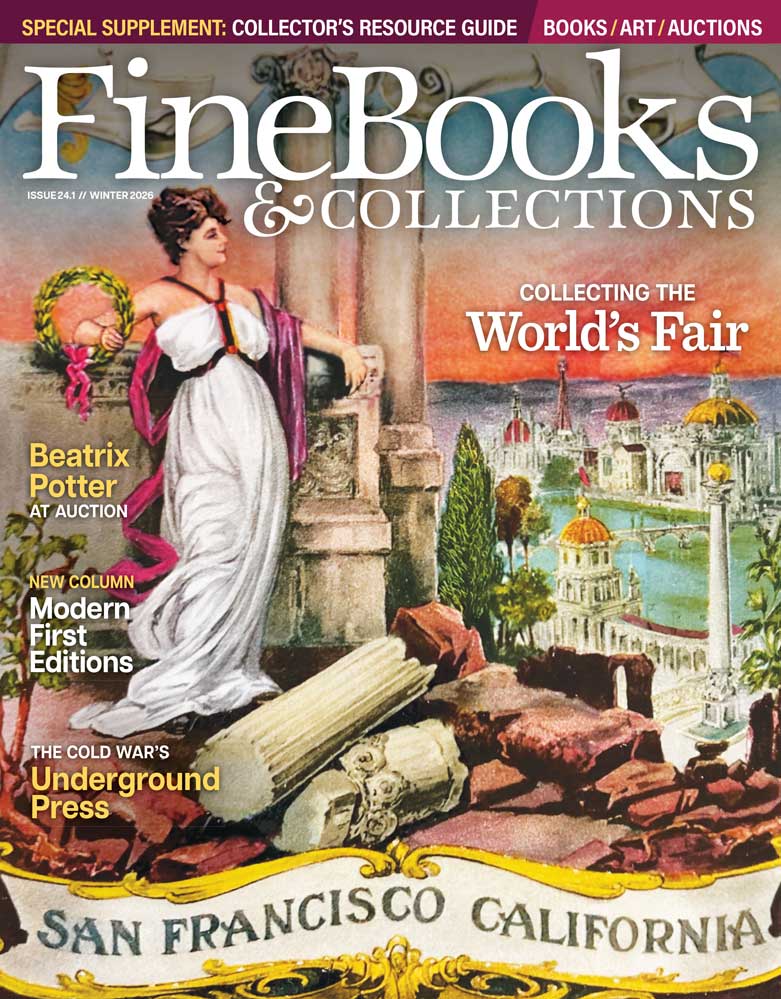
Three times a year, book collectors gather to attend major antiquarian book fairs in the U.S.--this year they will be held in the San Francisco Bay Area of California in February, New York City in March, and Boston in November. To facilitate and encourage participation, Fine Books pulls together information about the book fairs, auctions, exhibitions, and more available to those who would like to join in the fun during each Rare Book Week.

Screen Shot 2017-01-17 at 7.59.11 PM.pngWithout further ado, we present this year's edition of Rare Book Week West, which runs (roughly) February 5-12. Here you'll find information about the upcoming California International Antiquarian Book Fair, the CODEX book fair and symposium, a special PBA Galleries auction, and a dozen exhibitions and events (e.g., receptions, classes, open houses) of related bibliophilic interest, plus a few suggestions for "bookish browsing" while in the Bay Area. From the American Bookbinders Museum to the William Blake Gallery, whether your interest is in private press or Chinese book design or Alice in Wonderland, if you're headed to Cali for the book fair(s), be sure to check out our guide.