Shakespeare's House in London Finally Pinpointed
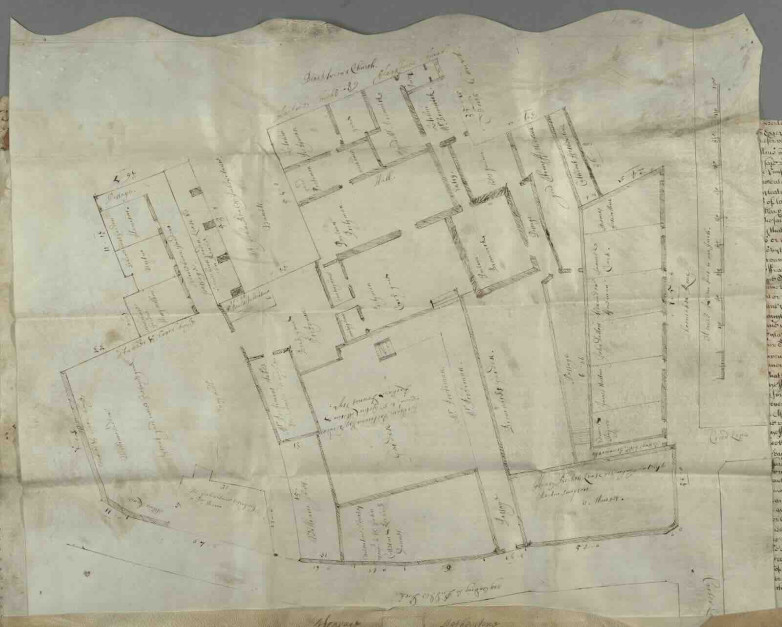
Property plan of the parish of St Ann Blackfriars



The precise location of William Shakespeare’s only London property in a quiet street in Blackfriars has been confirmed after the discovery of a previously unknown floorplan.
In addition to identifying the property Shakespeare bought in 1613, Professor of Shakespeare and Early Modern Literature at King’s College London Lucy Munro has also determined the layout and size.
It has been known since the 18th century that in his later years Shakespeare owned a property in Blackfriars, thought to be part of what was known as 'the Great Gate' over the entrance to the Blackfriars precinct, an important 13th century Dominican friary. Indeed, a dark blue plaque on the 19th century building at 5 St Andrew’s Hill states: “ON 10TH MARCH 1613 WILLIAM SHAKESPEARE PURCHASED LODGINGS IN THE BLACKFRIARS GATEHOUSE LOCATED NEAR THIS SITE”.
In the London Archives Professor Munro has now uncovered a plan of part of the Blackfriars precinct, drawn up in 1668, after the Great Fire of London, which confirms the precise location and size of Shakespeare’s house. The plan doesn’t indicate its internal layout or rooms, but it was substantial enough to have been divided into two houses by 1645.
It has been thought that Shakespeare retired from his London theatre career not long after he purchased the Blackfriars house in 1613, returning to Stratford-upon-Avon where he had a comfortable life. However, this discovery suggests that Shakespeare spent more time in London in his later years.
“I was doing research as part of a wider project and couldn’t believe it when I realised what I was looking at, the floorplan of Shakespeare’s Blackfriars house," said Professor Munro. "It had been assumed that there wasn't much more evidence to gather about it, so research on it has laid dormant for a while. These findings really help us tell the complete story of Shakespeare’s Blackfriars house and thanks to this new discovery we now know exactly where it stood.
“We know that Shakespeare co-authored Two Noble Kinsmen with John Fletcher later in 1613 and this new evidence that the Blackfriars house was quite substantial makes it not inconceivable that some of it may have been written in this very property. We also know that Shakespeare was visiting London in November 1614 so is it not likely that he stayed in his own house?"
Two other documents relate to the sale of the Blackfriars property by Shakespeare’s granddaughter Elizabeth Hall Nash Barnard, the daughter of Shakespeare’s eldest daughter Susanna. They show for the first time how and when the property left the possession of the writer’s descendants and how much they sold it for. Shakespeare's granddaughter sold the property in 1665 and it was destroyed in the Great Fire of London a year later.
The carefully drawn plan confirms that the property covered what are now the eastern end of Ireland Yard, the bottom of Burgon Street and parts of the late-19th century buildings at 5 Burgon Street and 5 St Andrew’s Hill, therefore it can now be confidently said that the blue plaque on 5 St Andrew’s Hill is not merely “near” the site of Shakespeare’s London house, but actually on the spot.
Over the past century, occupants of the buildings which were built on the location of Shakespeare’s house was have included printing company Judd and Co., printing inks manufacturer Stoer Brothers & Coles, the National Book Association, and firms of builders, carpet wholesalers, chartered surveyors, investment managers, and residents of apartment conversions.