Bonnie and Clyde's Poetry to Auction
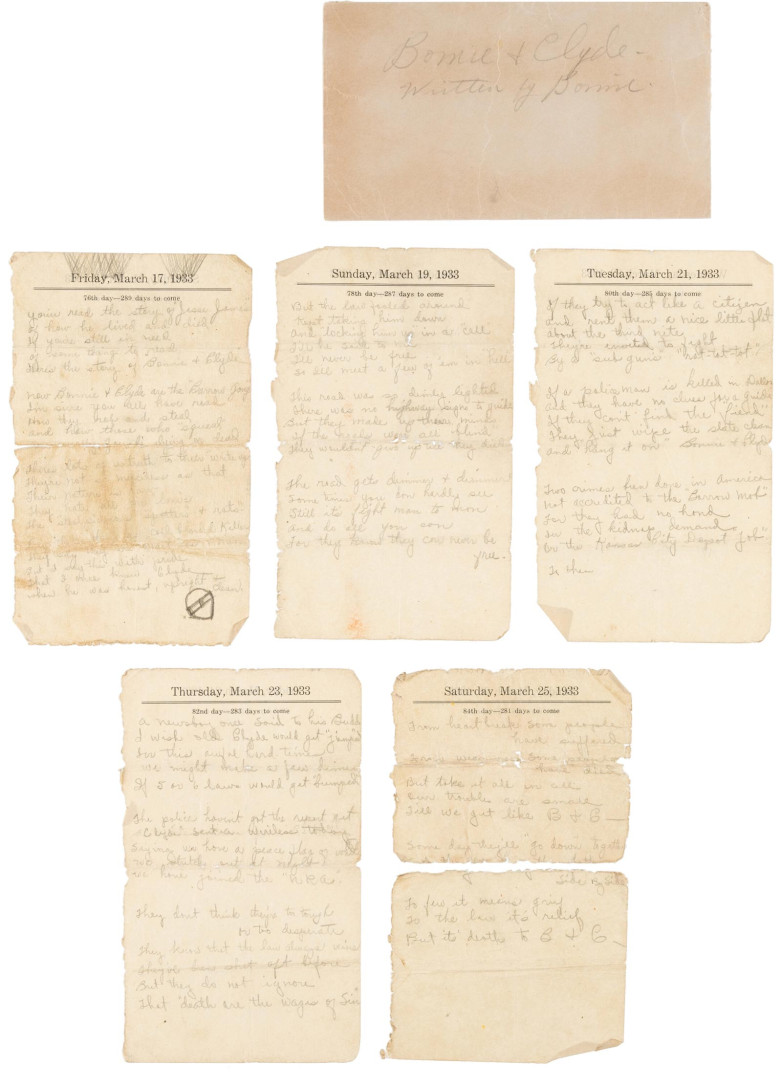
The Bonnie & Clyde poetry lot



Bonnie Parker & Clyde Barrow: Poetry Attributed to the Folk Hero Outlaws will feature in Heritage Auctions' April 24-25 online Americana & Political auction.
It comes in an archive of ephemera consigned by Barrow’s nephew, who got it directly from his mother, Clyde’s older sister featuring a small green leatherette appointment book for 1933 that was discarded by its golf-playing original owner before ending up with Bonnie and Clyde who repurposed it as a journal for poetry. Many of the contained verses revolve around their lives of crime and efforts to elude capture and prosecution.
When they were killed in a 1934 ambush, Bonnie’s mother Emma and Clyde’s sister Nell wrote a history entitled Fugitives: The Story of Clyde Barrow and Bonnie Parker which also features in the lot. Clyde also wrote a poem, with language that reveals his minimal education and is full of gangsterese language.
"Bonnie s Just Written a poem / the Story of Bonnie & Clyde. So / I will try my hand at Poetry / With her riding by my side. We donte want to hurt anney one / but we have to Steal to eat. / and if it's a shoot out to / to live that's the way it / will have to bee. / We have kidnapped some / people. And tied them to a tree / but not so tight that after we / were gone tha could not get / themselves free. / We are going home tomorrow / to look in on the folks. We will / meet then out near Grape Vine / if the Laws donte get there / first. / Now that's not as good as / Bonnies. So I guess I / Will call it a flop- / But please God Just one / moore visit before we are / Put on the spot."
“Few criminals in American history have captivated public attention like Bonnie and Clyde,” said Ray Farina, Historical Consignment Director at Heritage Auctions. “Their story became the subject of songs and movies, so to have something that they wrote is an incredible opportunity because it tells their story from a perspective nobody else can.”
Other highlights from the sale include a pen used by President Lyndon B. Johnson to sign the 1964 Civil Rights Act, and a rare real-photo postcard, postmarked May 21, 1937, depicting the Hindenberg less than three weeks after its disastrous destruction, plus two pages of original photos extracted from a family album containing numerous original photographs documenting the smoldering wreckage.