Rare Japanese Illustrated Books in New Art of Japanese Publishing Exhibition
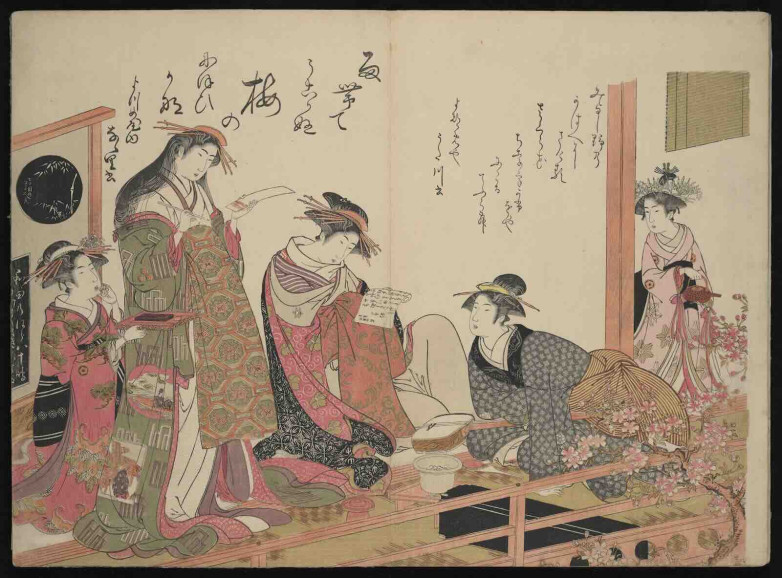
Kitao Masanobu's Yoshiwara Courtesans



Princeton University Library focuses on the art and evolution of Japanese publishing in its The Art of Japanese Publishing exhibition opening today.
It features selections from Marquand Library’s collection of rare Japanese illustrated books from the 17th century to the 20th century, and runs through December 6. It is co-curated by Nicole Fabricand-Person, Japanese Art Specialist, Marquand Library of Art & Archaeology and Holly Hatheway, Director, Marquand Library of Art & Archaeology.
“Before the commercial printing of illustrated books, art in the form of paintings and decorative arts was only affordable to the upper classes through private commission," said Fabricand-Person, who received an undergraduate degree and Ph.D. in Japanese Art and Archaeology from Princeton University. "Illustrated books opened up access to art for the first time to large urban audiences, and much of this was being created by the same artists working for elite sponsors.”
This artistic revolution was the result of newly-minted publishers in Kyoto, Osaka and Edo, who began to experiment with woodblock printing which for more than a 1,000 years had been restricted to Japanese temples for the production of Buddhist texts. These beautifully illustrated and commercially published books and subsequent single-sheet prints not only affected the Japanese art tradition but, in the 19th century, inspired the Western art movements of Impressionism, Japonisme and Art Nouveau. The publishing of illustrated books was then revolutionized in the 20th century with the introduction of photography, new printing processes, and artists taking complete control of their work for the first time.
“The ‘art of Japanese publishing’ demonstrates the importance of illustrated books and serials to the Japanese art tradition," said Hathaway. "Woodblock-printed books, for example, were designed by the same artists and published by the same publishers as the much-lauded Japanese print and yet are often ignored in art history texts and classes. In the 20th century, serials and self-published books were instrumental in promoting art created ‘for art’s sake’ for the first time in Japan.”
Nine of the items in the exhibition were formerly part of the Shibui Collection collected by Japanese art professor and scholar Kiyoshi Shibui in the early 20th century. These books are either the only copies still extant or one of very few remaining and represent the earliest examples of ukiyo-e (pictures of the floating world) and the beginning of Japanese commercial publishing.
Highlights include:
- Four Scenes of Lovemaking, a handscroll fragment of the earliest known printed work of ukiyo-e from 1660
- Kitao Masanobu's Yoshiwara Courtesans: A New Mirror Comparing the Calligraphy of Beauties (1784), one of the most important examples of 18th century publishing produced with 15 richly saturated colors, sprinkled mica powder, and embossed designs, the book features the culturally refined courtesans of the Yoshiwara pleasure quarters and their elegant calligraphy
- Kitagawa Utamaro's Poem of the Pillow (1788) which is believed to be Utamaro’s first erotic book