Lost Copy of Earliest English Language Poem Discovered in Rome
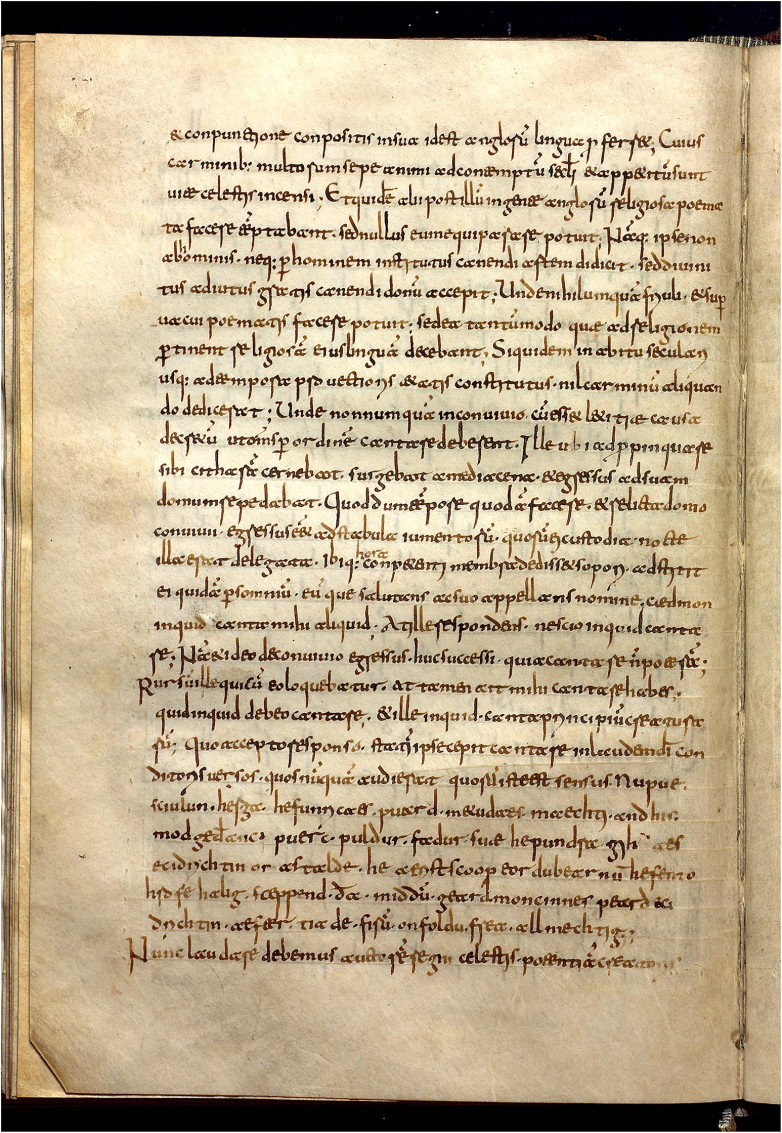
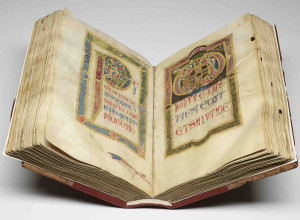
The rediscovered 9th century manuscript of Caedmon’s Hymn



An early 9th century manuscript containing a text of Caedmon’s Hymn has been discovered in Rome by researchers from Trinity College Dublin.
The newly-discovered manuscript in the National Central Library of Rome dates from between the years 800 and 830, making it the third oldest surviving text of the poem. The find is particularly significant because the Latin manuscript contains the poem in Old English in the main body of the text. The two older copies in Cambridge and St Petersburg have the poem in Latin, with the Old English text only added in the margin or at end.
Written over 1,300 years ago, Caedmon’s Hymn is a nine-line poem praising God for the creation of the world. It is said to have been composed by a cowherd from Whitby in England after a divine visitation. The poem was composed in Old English and survives today thanks to its inclusion in copies of the Ecclesiastical History of the English People, an 8th century history of England written in Latin by the Venerable Bede, an English monk.
The manuscript was discovered by medieval manuscript experts Dr Elisabetta Magnanti and Dr Mark Faulkner from the School of English.
“I came across conflicting references to Bede's History in Rome," said Dr Elisabetta Magnanti, "some pointing to its existence and some indicating it was lost. When its existence was confirmed by the library and the manuscript was digitised for us, we were extremely excited to find that the manuscript contained the Old English version of Caedmon’s Hymn and that it was embedded in the Latin text.
“The magic of digitisation has allowed two researchers in Ireland to recognise the significance of a manuscript now in Rome, containing a poem miraculously composed in Northern England by a shy cowherd a millennium and a half ago. This discovery is a testament to the power of libraries to facilitate new research by digitising their collections and making them freely available online.”
Dr Mark Faulkner added: “Unearthing a new early medieval copy of the poem has significant implications for our understanding of Old English and how it was valued. Bede chose not include the original Old English poem in his History, but to translate it into Latin. This manuscript shows that the original Old English poem was reinserted into the Latin within 100 years of Bede finishing his History. It is a sign of how much early readers valued English poetry.”
The newly-discovered manuscript of Bede’s History is one of at least 160 surviving copies. This manuscript was produced at the Abbey of Nonantola in Northern Central Italy between 800 and 830 and is now in the National Central Library in Rome. According to the researchers it was stolen from the church of San Bernardo alle Terme in Rome where with other manuscripts it had been sent for safekeeping amid the Napoleonic Wars in the 1810s. Then it changed hands privately a number of times before being acquired by the National Central Library of Rome. Its complex ownership history meant that the manuscript had been regarded as lost by Bede scholars since 1975 and no one realised it contained a copy of Caedmon’s Hymn until the National Central Library of Rome digitised the manuscript.