Benjamin Franklin's Ink-Stained Autobiography in New Damaged Goods Exhibition
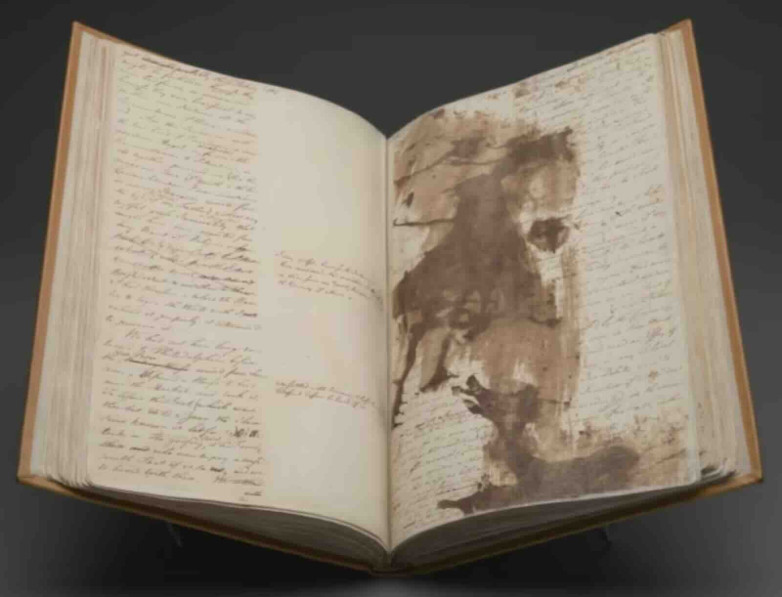
Benjamin Franklin, ink-stained draft of The Life of Benjamin Franklin, 1771-1789



Damaged Goods on view in the Huntington Art Gallery’s first floor brings together books and document marked by natural processes, human error, and intentional acts of censorship.
Running through November 30 at the Huntington in San Marino, California, the central object in the exhibition is Benjamin Franklin’s draft manuscript of his autobiography. It has long been believed that Franklin knocked over the inkwell that left a large stain on the page.
Other highlights include:
- Hirose Tomoshige’s Sanpō chie no umi taizen (Practical Mathematics for Commerce), an Edo-period arithmetic guide with pages bored through by bookworms
- Alexander Gardner’s last official portrait session with Abraham Lincoln featuring Gardner’s 'cracked-plate' portrait, made weeks before Lincoln’s assassination, showing how a glass plate negative likely broke under thermal stress; Gardner placed the two pieces together to create a single print before discarding the negative
- Alexander Wilson’s American Ornithology, one of the first major books on North American birds, displaying ink from an illustration which reacted with the facing page to create a brown 'ghost image' of an ivory-billed woodpecker believed to be extinct
“Imperfections often tell us as much as the works themselves,” said Erin Chase, associate curator of architecture and photography. “These marks, stains, and alterations preserve moments of use, emotion, and human intervention that might otherwise be lost to history.”
Running alongside at the Huntington Art Gallery is a second exhibition, The Mirror of the Moon, which shows how writers, artists, and scientists have traced their ideas onto the lunar surface. Items on display include:
- Galileo Galilei’s Sidereus nuncius (Starry Messenger), the 1610 publication that recorded his groundbreaking telescopic observations of lunar craters and mountains
- Johannes Regiomontanus’ 1476 Calendarium which predicted lunar and solar eclipses with striking precision
- George Gilden's early 17th-century A Meteorological Dyary and Prognostication for This Present Yeare of Our Lord which calculated and illustrated a lunar eclipse amid broader astrological, technical, and household knowledge
- Octavia E. Butler's 1969 notebook documenting the Apollo 11 moon landing as it unfolded on television, recording times, data, and astronaut Neil Armstrong’s first words from the lunar surface
- prints from the Observatoire de Paris’ Atlas photographique de la lune (Photographic Atlas of the Moon) produced between 1896 and 1910
- a 1992 photographic mosaic made by NASA’s Galileo spacecraft showing the moon’s north pole