Theodore Roosevelt's 1912 Milwaukee Speech and First Ladies' Letters Acquired by Library of Congress
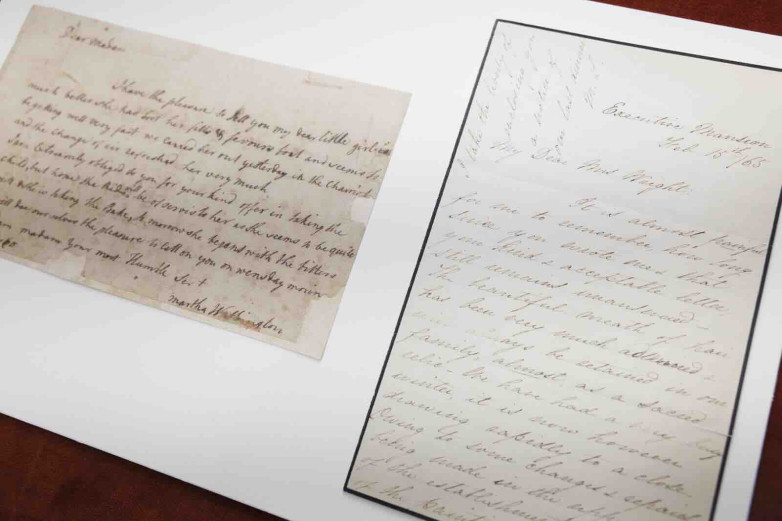
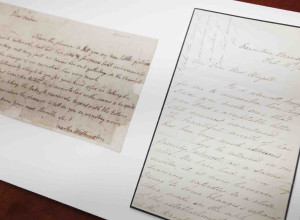
Letters written by Martha Washington (September 29, 1760) and Mary Todd Lincoln (February 15, 1865)


The Library of Congress has acquired a bound volume containing 15 tipped-in pages of a stenographic version of Theodore Roosevelt's Milwaukee, Wisconsin, speech of October 14, 1912. The pages record the speech Roosevelt delivered from the auditorium stage after receiving a gunshot wound from attempted assassin John Schrank outside the Gilpatrick Hotel.
This copy of Elbert Martin's typed stenographic version of Roosevelt's speech contains numerous pencilled emendations and alterations to the text made by Roosevelt himself. When Roosevelt made the changes, and for what purpose or publication, are not currently known (the holes that are visible on the first two pages of the document are unrelated to the assassination attempt and are not bullet holes).
“The assassination attempt and Roosevelt's ‘it takes more than that to kill a Bull Moose’ response to his wounding represents a famous episode in Theodore Roosevelt's noteworthy life, and this version of his speech offers another medium through which to explore the significance of events in Milwaukee in the context of the 1912 election and Roosevelt's legacy,” said Michelle A. Krowl, curator of the Theodore Roosevelt Papers.
The Library of Congress has also recently acquired two letters written by former first ladies Martha Washington and Mary Todd Lincoln.
On February 15, 1865, two months before the assassination of her husband, Mary Todd Lincoln corresponded with Mrs Caroline R. Wright, wife of the former governor of Indiana. In her letter, Lincoln mentions a “beautiful wreath of hair” which historians believe to be the “Hairy Eagle”, a framed woven figure of an eagle sitting on a globe, made entirely of hair contributed by notable politicians and several of their respective wives including President Lincoln and the first lady. Mrs Wright commissioned the piece to raise money to help sick and wounded Civil War soldiers and intended for it to be a gift to the Lincolns.
Mary Lincoln’s stationery contains a thin black mourning band around the edge of the first page, likely acknowledging the death of the Lincolns’ son William three years earlier. Mrs. Lincoln enclosed a notice of “our last dinner” which may have been an article about the state dinner held the day before. She also mentions that due to painting taking place in the Executive Mansion “we will be deprived of several charming visitors, yourselves included on the 1st of March, yet if you locate yourselves at Willard’s…” suggesting a possible stay at what was the mid-19th century predecessor to today’s Willard InterContinental on Pennsylvania Avenue. The visit may be a reference to President Lincoln’s second inauguration on March 4 during which he proclaimed “With malice toward none; with charity for all….”
In a letter written September 29, 1760, to Margaret Bolan Green, Martha Washington describes the recovery of her four-year-old daughter “Patsy” (Martha Parke Custis) from a recent illness that included “fitts & fevours”. The widowed Martha Dandridge Custis married George Washington in 1759 and together they parented two surviving children from Martha’s first marriage, Patsy and John “Jacky” Parke Custis. Patsy would later die at the age of 17 from her continued illness. Martha Washington outlived all four of her children; she and Washington raised two of her grandchildren after the death of Jacky in 1781.
The letter, written after George Washington was commander of the Virginia Regiment during the French and Indian War but before he became the first president of the newly formed United States, provides rare documentation of Martha’s daily life and personal history, as few of her letters survive. The library’s George Washington Papers contain 11 letters written by Mrs. Washington, but none in her own hand.