
Why Some Libraries Are Preserving Their Card Catalogues

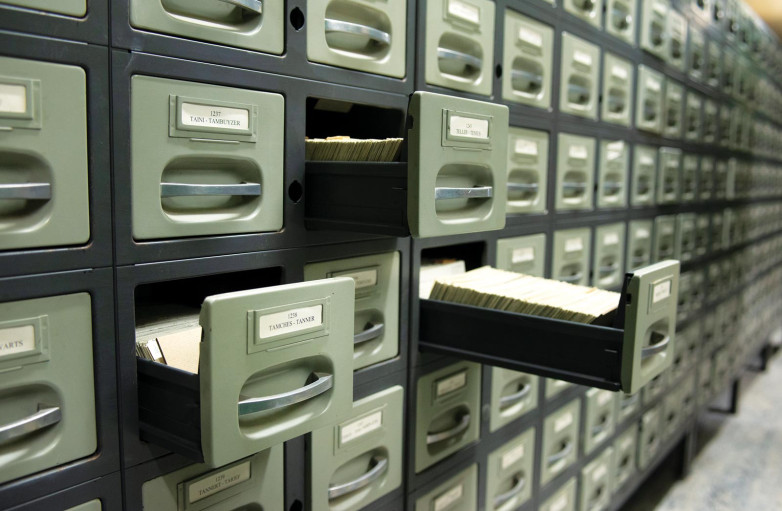
Photo by Jesse Huiskamp - KU Leuven Imaging Lab

The KU Leuven Libraries in Belgium are among the institutions that have chosen to keep their physical card catalogues even as digitization makes them obsolete.

Walk toward the main reading room at the Library of Congress (LOC) in Washington, DC, and you’ll see drawers packed with cards. Readers can still search this public catalogue, look up an item based on the title or author, and locate it through the call number. They might even spot a card dated to 1938, detailing a book authored by J. Edgar Hoover, the former FBI director who once worked at the LOC. The notes were written in what’s known as library hand, a specific handwriting style that is legible and consistent.

“This is a snapshot of that moment in time when that book was collected,” David Brunton, acting associate librarian for discovery and preservation services at the LOC, told FB&C.

Indeed, in April this year, the LOC brought fifty-six of its card catalogue cases out of retirement and set them up as kiosks across the country. These cards contain bibliographic details, perhaps even provenance notes, some of which have not been transferred to electronic systems. Books have even been written about cataloguing systems, including The Card Catalog: Books, Cards, and Literary Treasures (2017) from the LOC’s archives and Markus Krajewski’s Paper Machines (2023).

In an age when data can be summoned with the click of a few buttons on an electronic catalogue, library card catalogues of old might feel redundant. Drawers full of cards, inscribed with details of each book, used to be the method for working with library collections. Today, libraries around the world are making decisions about what to do with these materials. Should they go through the shredder, be kept in use, or be preserved?

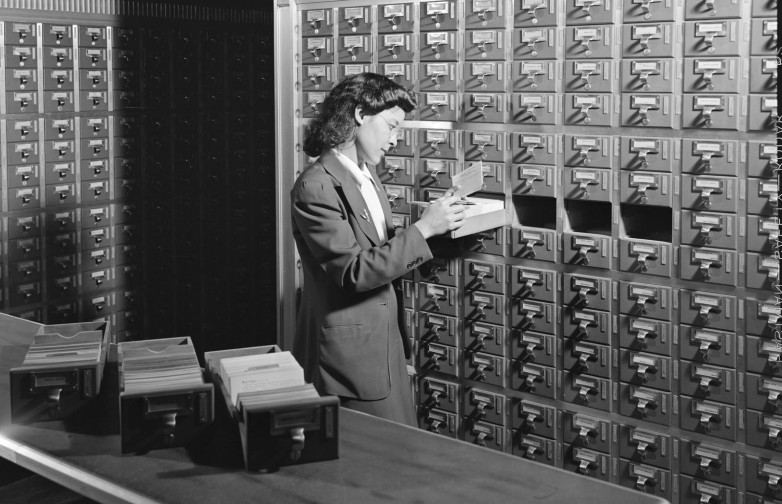
Courtesy Library of Congress

Jewell Mazique, a clerk at the Library of Congress, photographed by John Collier Jr. in 1942

For Brunton, there’s a tension between what libraries have space for and what is useful. “It’s easy to let nostalgia get in the way,” he said. Cards do, after all, take up space and wear out. On the other hand, “Libraries are guardians of the cultural memory.” 

At the LOC, the staff are taking a cautious approach. Off-site at its Fort Meade facility, an almost identical catalogue is housed in an environmentally optimized space, with barcodes on boxes. These cards were once kept in a staff area at the library, and many are peppered with handwritten notes. Now, researchers can ask staff to retrieve the cards.

Meanwhile, in Belgium, the physical card catalogue at the KU Leuven Libraries has been superseded by a digital catalogue. The old cards are now stored in their original boxes at their historical building, the university library, in a stack room accessible only to staff. There are over one hundred of these cabinets, each with eight rows of two drawers, the majority of which contain cards for titles organized by author (or title for anonymous items), while others are specific to subjects, periodicals, newspapers, and acquisitions.

On rare occasions, curators examine the cards of early-printed books, which are not all plugged into the electronic catalogue. Beyond this, the libraries’ representatives state that there are some keywords on the cards that have not made it to the electronic catalogue—this was the main reason they decided to preserve the cards rather than dispose of them, and it could offer an interesting area for research.
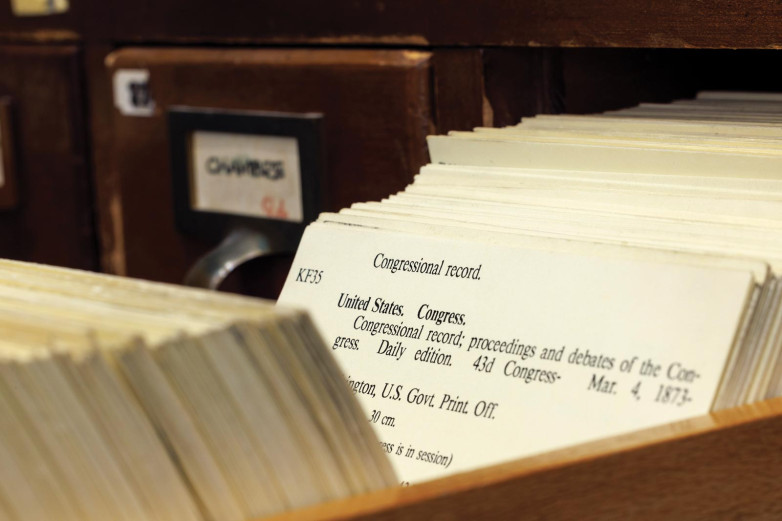

Photo by Shawn Miller/Library of Congress

The Library of Congress continues to care for its card catalogues, although they’re no longer in demand for daily use.

Yet as more and more information is recorded electronically, the need to keep the card catalogue is fading. Hilde Van Kiel, director of the KU Leuven Libraries, said: “At this moment, the card catalogue is preserved because it has become a form of heritage in and of itself, because it documents the history of our library collection, and—to be frank—because it is currently not in the way.”

She explained that if they ever desperately need the space, they’ll have to carefully balance the value of the card catalogue as a historical artifact with the value of the space it is taking up. The KU Leuven Libraries have their own interesting history, which the card catalogues help to preserve. They date back to the rebuilding of the collection after World War II and preserve a split in the Catholic University of Leuven’s collection into Dutch- and French-speaking parts that took place in the 1970s, when the French-speaking part of the university found a new home around 30 kilometers away.

“In our case, the card catalogue is more than just meta-dated records; it also represents a part of our library’s history: the division of the university and of the libraries’ collections,” said An Smets, the libraries’ curator of special collections. “This makes it a valuable artifact for us to preserve. It documents the rebuilding of our library’s collection after the loss we suffered during the Second World War.”

Tjamke Snijders, the head of special collections at the KU Leuven Libraries, argues that the history of meta-dating is interesting in and of itself and has a long history, including medieval monasteries that would avoid listing books they would rather hide from view.

Snijders said, “The practices and cultural norms around meta-dating books—what do we note on a card or in a catalogue, how do we note it, who has access to that data—is a fascinating instance of immaterial cultural heritage. The card catalogues are fundamental elements of that heritage.”

For libraries around the world making decisions about whether to keep their card catalogues, they may need to think beyond practicality. There is also the question of the extent to which these cards preserve history.