Rare First Editions by Copernicus, Galileo, Kepler, and Newton at Sotheby's
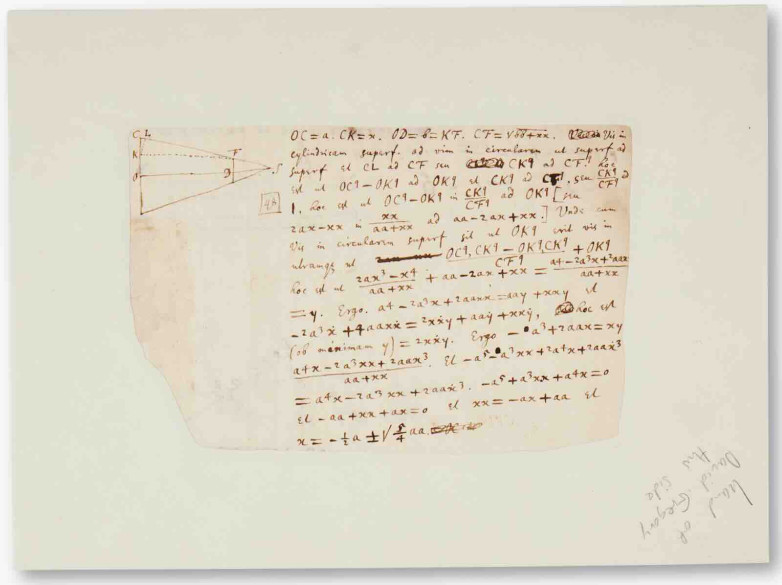
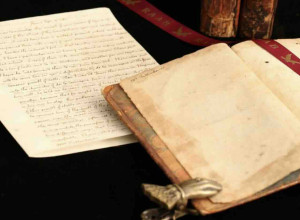
Isaac Newton, autograph manuscript worksheet, Cambridge, May 4–8, 1694



The first of a two-part single-owner auction Reason and Revolution focusing on the history of scientific thought comes to Sotheby's next month.
Featuring first editions from Nicolaus Copernicus, Galileo Galilei, Johannes Kepler, and Isaac Newton including a rare surviving manuscript in Newton's own hand, a number of these items passed through the library of Sturgis S. Dunham and his son Robert S. Dunham before entering the present collection. A second sale in December will centre on the founding of the American nation.
Leading the sale is Nicolaus Copernicus's De revolutionibus orbium coelestium (Nuremberg, Johannes Petreius, 1543, estimate: $700,000–$1m). This is a first edition of the significant 16th century publication proposing that the earth orbits the sun rather than standing at the center of creation.
Other highlights include:
- Euclid's Praeclarissimus Liber Elementorum in Artem Geometrie (Venice, Erhardt Ratdolt, May 25, 1482, estimate: $240,000–$360,000), the first printed edition of Euclid's Elements, the first to successfully integrate the geometric diagrams - more than 500 of them - directly alongside Euclid's text
- an Isaac Newton autograph manuscript worksheet (Cambridge, May 4–8, 1694, estimate: $500,000–$700,000), a rare manuscript in Newton's own hand, revisiting calculations related to his Principia and produced during his celebrated visit with the astronomer David Gregory at Cambridge
- Galileo Galilei's Sidereus Nuncius (Venice, T. Baglioni, 1610, estimate: $250,000-$350,000), a first edition of Galileo's account of his earliest observations through the telescope, including his discovery of the four moons of Jupiter and the mountainous, cratered surface of the moon, the book that established Galileo as the founder of modern observational astronomy.
- Johannes Kepler's Astronomia Nova (Prague/Heidelberg, E. Vogelin, 1609, estimate: $400,000–$600,000), first edition of Kepler's masterwork in which he set out the first two of his three laws of planetary motion, that planets travel in ellipses rather than perfect circles, and that they sweep out equal areas in equal times
- Isaac Newton's Philosophiae Naturalis Principia Mathematica (London, Joseph Streater, for the Royal Society, 1687, estimate: $500,000–$700,000), first edition, first issue, in which Newton sets out the three laws of motion and the law of universal gravitation, providing for the first time a single mathematical framework unifying the mechanics of the heavens and the earth
Additional highlights include Tycho Brahe's Astronomiae instauratae mechanica (Wandsbek: [for the author], 1598, estimate: $200,000–$300,000), and On the Tendency of Species to Form Varieties, and on the Perpetuation of Varieties and Species by Natural Means of Selection by Charles Darwin and Alfred Russel Wallace (London, Longman, Brown, Green, Longmans & Roberts, and Williams and Norgate [for the Linnean Society], 1858, estimate: $150,000–250,000).
“There is something remarkable about holding the actual page where a scientific revolution happened, not a later account of it, but the object itself, like the sheet where you can watch Newton work through a calculation in his own hand," said Dr Kalika Sands, Sotheby's Vice President, Head of Books & Manuscripts, Americas. "How often do we get to stand that close to the moment a discovery became permanent?”