




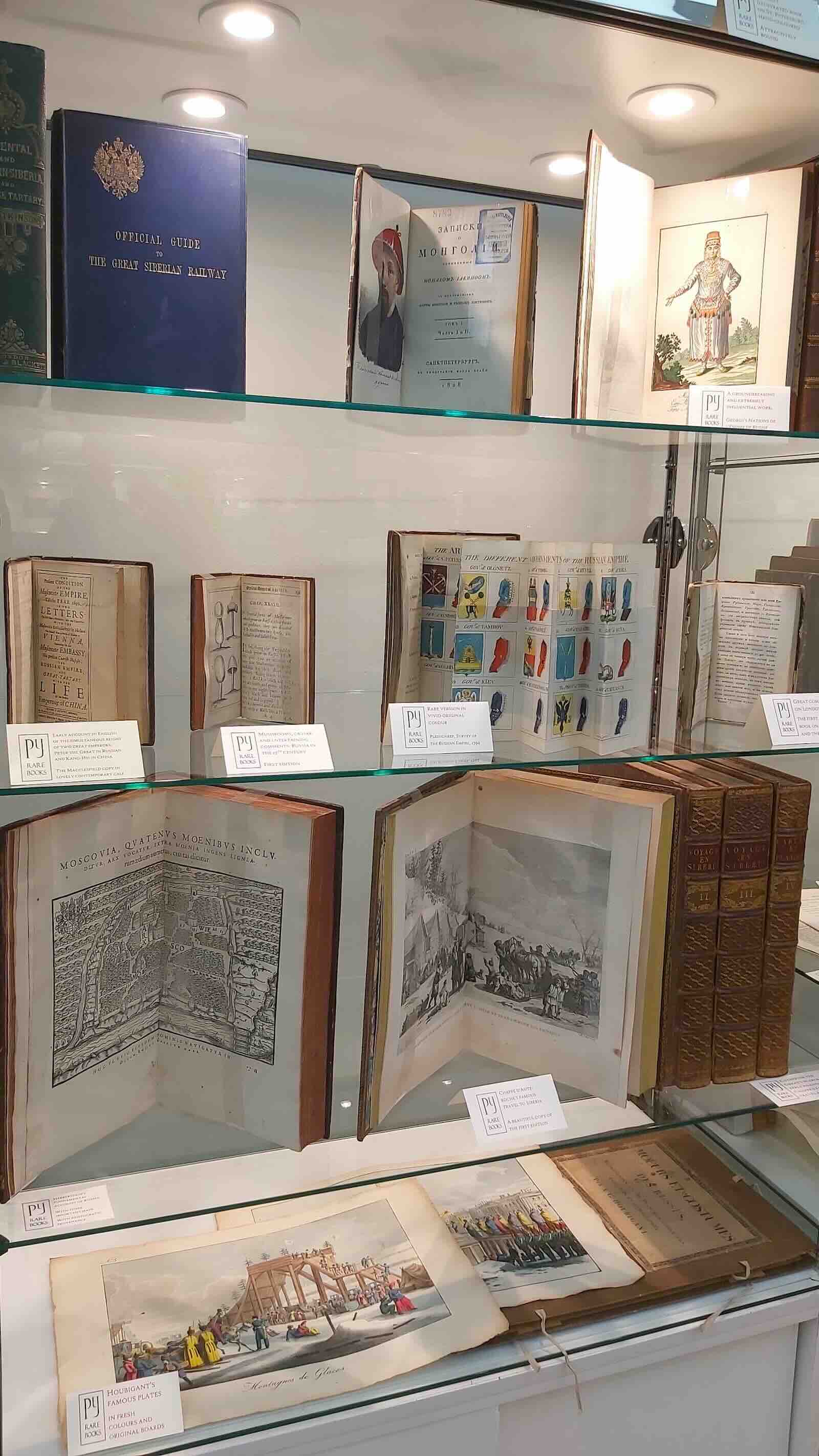
What do you love about the book trade?
I love the orientation towards physical objects, which is what I’ve been most interested in since my time studying Art History. This is intertwined with the detective aspect of the work which I enjoy just as much: there is always room for discovery in this trade, and careful, attentive engagement with the objects is the key. I also value the way this work constantly pushes me to acquire new skills and areas of knowledge. To list a few examples in my case, this has ranged from learning very basic Uzbek and working with endangered Siberian languages to developing some expertise in Russian Imperial military uniforms from the 1830-50s.
Describe a typical day for you:
I work from my home in New York, or occasionally from the New York Public Library. As I mentioned earlier, most of a typical workday is spent researching and writing book descriptions. Sometimes this research takes me to rather arcane corners of the internet, such as early 2000s alchemy forums which turned out to be the only places where I could find complete scans of 18th century Russian material on the subject. The people there take their alchemy very seriously. I tend to alternate these research deep dives with less time-consuming tasks, though the exact balance always depends on the time of year.
Favorite rare book (or ephemera) that you’ve handled?
My favorite kind of book is something with a story, especially when I can play a part in uncovering that story. One of the most exciting examples of this was a very rare first edition of the first ABC printed in Russia (1634) in its original binding. An intriguing case was a small pocket edition, printed in Berlin in 1943, of Georgia’s national epic, Shota Rustaveli’s Knight in the Panther's Skin. It turned out to be one of 500 copies produced by Nazi Germany for the Georgian Legion, an army unit formed from Georgian prisoners of war and émigrés. Our copy was one of 50 deluxe numbered copies for officers. Most of the Legion perished when they rebelled against the Nazis in Spring 1945, and apparently almost every copy as well. Only two other examples are known, both in Georgian libraries.
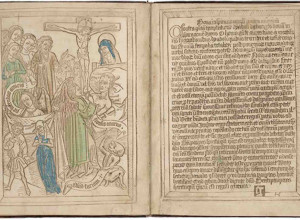
Another category of material I’m especially fond of is the illustrated manuscripts of the Old Believers. After opposing the mid-17th century reforms of the Russian Orthodox Church and being banned from printing their religious texts, the Old Believers developed an extraordinary manuscript tradition. Often containing some fascinating moral tales or Gospel fan fiction, they boast truly delicious styles and decorations, to the point where they can be appreciated as independent works of art.
What do you personally collect?
My personal collection is still modest, but I hope to expand it. One of my interests is eccentric examples of book printing that tell deeper truths about their time. One such example is a copy of a rather awkward miniature edition of Lenin’s quotations for youth, decorated with flip-book-style photomontages of Soviet youth whose faces, on closer inspection, express fear and confusion.
What do you like to do outside of work?
Learning languages and trying to make my French sound adequately professional, if we can consider it something “outside of work”. Otherwise, we have a subscription to The Criterion Collection and have lately been indulging in Werner Herzog’s documentaries and films by David Lynch or Eric Rohmer. I also go regularly to the Met Museum, the Frick Collection, the opera, and read, of course.
Thoughts on the present state and/or future of the rare book trade?
I’m not pessimistic about current technological advances at the moment. I’m grateful for the near-unlimited access we now have to digitized primary sources and scholarship, which makes higher-quality research possible more quickly and often leads to new discoveries. I also see that AI cannot replace human research, as it's far too eager to make things up in standardised and noticeable patterns. My art dealer friend has recently told me that in the past he had wished for a machine to authenticate artworks, since experts in his field can sometimes be difficult to trust for various reasons. Well, there is no satisfactory machine for this, at least at the moment. And uploading an image of the work in question to a program has proven, for the most part, useless. In just the same way, the material side of the book trade makes it harder to automate or supplant than many other fields.
As for demand, I understand the concerns about the decline of the humanities, and the cuts of institutional budgets. I also see increasing efforts to counterbalance this trend. Cultural interests move in cycles, and while they shift, the rare book trade has endured, and I believe it will continue to do so.
Any upcoming fairs or catalogs?
My personal favourite the New York Antiquarian Book Fair at the Armory is in late April and early May, and is soon followed by Firsts London Rare Book Fair in May. It will be an eventful spring!