Dr. Irene Malfatto of Bruce McKittrick Rare Books on Book Fairs and Illustrated Children’s Books
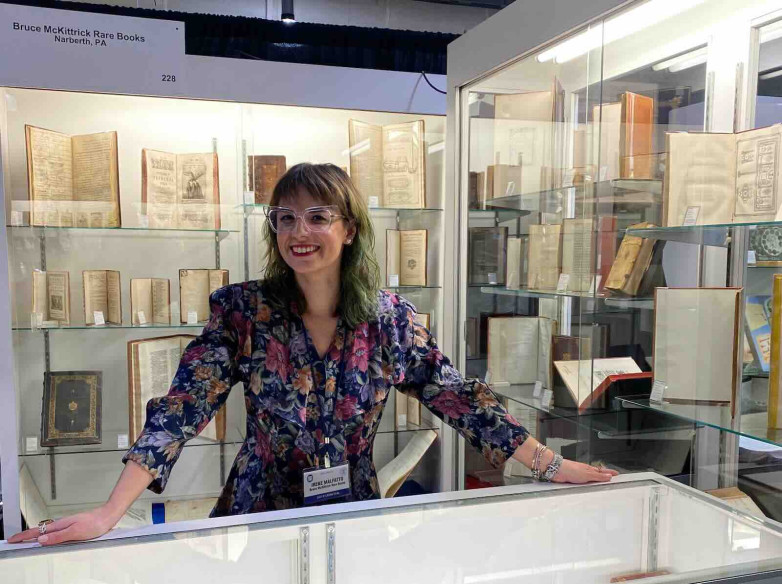
Irene Malfatto



Our Bright Young Booksellers series continues today with Dr. Irene Malfatto of Bruce McKittrick Rare Books in Pennsylvania:
How did you get started in rare books?
After finishing my PhD between Florence and London, I spent the first half of 2018 as an Invited Research Scholar at the John Carter Brown Library in Providence, Rhode Island. During that time, I was invited to a dinner party where I happened to sit next to Terry Belanger, the founding director of Rare Book School and arguably one of the most influential figures in the world of rare books in this country. During my conversation with Mr Belanger, I learned about a project he was working on at the time, cataloging the private rare book collection of Florence Fearrington, then housed in her Manhattan apartment and now at the Wilson Special Collections Library at UNC-Chapel Hill. Shortly after that dinner, Mr. Belanger invited me to join his team, and I began commuting to New York on a weekly basis.
When my contract at the JCB came to an end, I took up a temporary position as an adjunct instructor at Providence College but continued working with Ms. Fearrington’s rare books as a side gig. I was hooked. I first met Bruce McKittrick at the Boston Antiquarian Book Fair in the fall of 2018, and in December of that year I was invited to Philadelphia for an interview. My growing frustration with the academic world and some major issues in my relationship did the rest. In the summer of 2019, I left Providence, my house, my university job, and my spouse to begin my career as a rare bookseller in Philadelphia.
What is your role at Bruce McKittrick?
I have a PhD in Medieval Literature, so when I first interviewed for this job, I brought up my expertise in manuscripts and paleography. I thought Bruce McKittrick dealt exclusively in early printed materials, but to my surprise, I found out that very day that manuscripts had always been part of the business too, they were just waiting for the right person to come along!
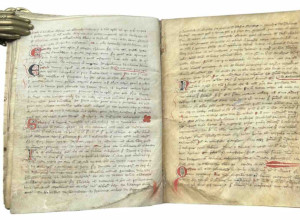
Everyone does a bit of everything in our office, but early on I sort of created for myself the role of “Manuscript Specialist”. Essentially, everything that’s written by hand goes through me, manuscript books and documents, marginal annotations in printed books, ownership inscriptions, etc. I spend most of my time researching newly acquired materials and writing descriptions, and over the years I’ve contributed to expanding our manuscript holdings by recommending a number of purchases. I’ve also prepared three catalogs devoted exclusively to manuscripts including our most recent one, Catalog 76.
What do you love about the book trade?
Compared with my previous career, working in the book trade has decidedly expanded my intellectual curiosity and interests beyond my niche academic field of study. I never thought I would be particularly invested in anything other than medieval monks, and here I am expounding on 16th century Italian naturalists and 18th century French salon culture.
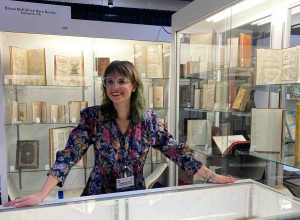
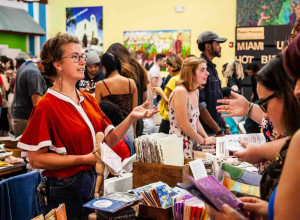
And I love the book fairs. I enjoy setting up the booth and curating the aesthetic dimension of our book displays. I have fun dressing up with permission to be a little eccentric, and I relish those moments when I get to share my excitement about a book with someone who is on exactly the same wavelength. Since entering the trade, I’ve had the opportunity to meet many wonderful younger colleagues, and over the past few years I’ve been trying to organize informal “young booksellers” social gatherings during the New York Antiquarian Book Fair.
Describe a typical day for you:
Our headquarters are in the Philadelphia suburbs, and I live in the city, so I have to wake up early and commute to work. As of today, I’m the only McKittrick employee who doesn’t live within walking distance from the office, I’m a city girl and intend to keep it that way!. My personal office is the smallest in the building and notoriously the most chaotic. It’s admittedly difficult to get in and out, so I tend to spend most of my day “in my cave”, as I like to put it, conducting hands-on research into the materials or getting lost in internet rabbit holes.
Oftentimes, the manuscripts I work with are the sole witnesses to otherwise unknown texts or shed light on otherwise obscure historical facts. The 'detective' component of my work really is what makes me love what I do, because it gives me the opportunity to make little discoveries every day. I very much enjoy sharing these epiphanies with my colleagues when I eventually emerge from hours of hyperfocus.
Favorite rare book (or ephemera) that you’ve handled?
Several medieval manuscripts come to mind, but my favorite was probably a c. 1480 copy of Regiomontanus’ Kalendarium, in German with numerous astronomical diagrams and two working volvelles. I spent a very long time learning how to read and interpret these instruments correctly, and I very much enjoyed sharing my newly acquired knowledge with visitors and potential clients at the New York Antiquarian Book Fair in May 2023. A few months later, I met the manuscript again at the institution where it now lives and had the opportunity to present it to a group of students.
What makes a great collector?
When it comes to medieval manuscripts, it’s not uncommon to come across collectors whose interest lies mainly in the artistic significance of illuminated miniatures, initials, and decoration. A great collector, to me, is one who equally values the history of the book-object itself and that of the text within. I especially appreciate it when a client’s purchase is motivated by a manuscript’s unique codicological features or by its relevance to the history of the transmission of a given text.
What do you personally collect?
I collect modern illustrated children’s books that retell medieval stories or relate to the Middle Ages more generally. I’m also drawn to medieval-inspired illustration and decorative elements, so I occasionally dip into Arts and Crafts territory. I have a soft spot for movable books - one of my most recent acquisitions is a c. 1960 pop-up about the travels of Marco Polo, and one of my most cherished is Nancy Willard’s Gutenberg’s Gift (1995), a whimsical pop-up about the invention of the printing press.
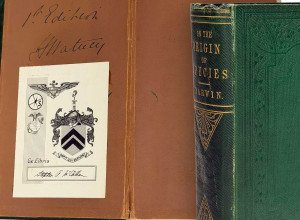
My grandfather was a bookseller, and I grew up in a house full of books, so I was raised with the conviction that buying books is always a good idea. Since my grad school years, I’ve been trying to acquire my own copies of the most important reference books in my field (medieval travel literature), preferably in their first editions. Among my favorite items in this second part of my collection are Henry Lee’s bizarre essay The Vegetable Lamb of Tartary: A Curious Fable of the Cotton Plant (1887) and the seminal The Medieval Alexander (1956), published after the untimely death of its 24-year-old author, George Cary.
What are your interests outside of work?
I never completely abandoned my academic research. I try to keep up with the scholarship as much as I can, and I occasionally publish articles or present papers on medieval travel and travel literature. Most recently, I contributed a chapter to The Cambridge Guide to Global Medieval Travel Writing (2025). I plan to publish my PhD dissertation one day, but I am in no rush.
I also have a variety of non-bookish hobbies that I cyclically pick up, abandon, and return to, among them playing electric guitar, making collages, and writing short stories. I like to ride my bike, practice hot yoga, and go to EDM shows. Most recently, I’ve been learning to DJ and mix tracks!
What changes in the rare book trade most excite — or concern — you?
As a former academic and teacher, I’ve been delighted to see the growing interest in manuscripts as educational tools. I like seeing faculty members and researchers involved in the acquisition process of manuscripts for institutional libraries, and I love hearing stories about “my” manuscripts being used in the classroom. Unfortunately, this entire side of the rare book business is currently suffering the consequences of political decisions that have been undermining the study of the humanities in this country.
Any upcoming fairs or catalogs?
I am currently seven months pregnant, so I doubt I’ll be able to put together a new manuscript catalog anytime soon! But as I mentioned earlier, Bruce McKittrick’s latest, Catalog 76, includes 35 manuscripts specially selected and described by me. Several of these will be on display with my colleagues at the upcoming Boston International Antiquarian Book Fair (November 6-8).