Advertising Index
Fine Books Classifieds
WorldView Antique Maps & Books
A Fine Selection of Antiquarian Maps, Charts and Books.
Quill & Brush
Serving the Book Community 45+Yrs. Over 20,000 Collectable Books
PRB&M
An independent, extensive, highly illustrated website.
Tavistock Books
First Editions, Rare & Collectible Books
PBA Galleries
Specialist in Exceptional Books & Private Libraries Bought at Auction
The Kelmscott Bookshop
Over 20,000 rare books in all subjects. Book Binding/ Restoration
Antiquarian Maps & Map Collecting
Map dealers, antique charts, views, elevations, prints, cartography.
Restoration Books
Bindery & Fine Press Perserving Historical Collections
Fine Books & Collections Contributor Guidelines
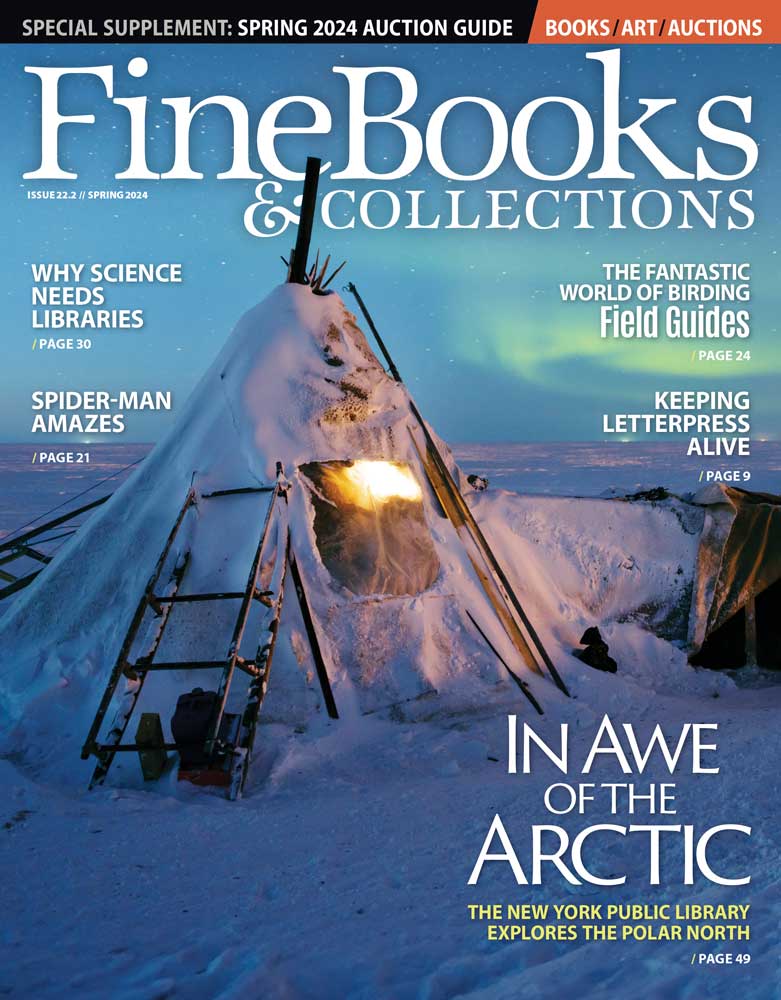
About Fine Books & Collections
Fine Books & Collections covers a broad range of topics and subjects of interest to book collectors and bibliophiles, from early manuscripts to modern first editions and everything in between. Our writers use the artifact—the book itself—as a starting place to tell an interesting story. Lists of facts, the minutiae of first edition identification, and author bibliographies are typically addressed in sidebars. The core of each article is an engaging narrative.
What We Don't Publish
(More information and examples are given at the end)
  • Bibliographies
  • How-to-collect articles
  • Genre overviews
  • "Gold in my attic stories"—tales of rare finds
  • Poems
Guidelines for Writers
  • We encourage contributors to consult with experts who can shed light on the subject, or perhaps express an opposing view. Most articles in FB&C include interviews with subject matter experts or quote from letters or books. We do not often publish stories that are just the author's opinion.
  • Articles should be written to both inform and entertain the reader. We typically work with academic writers to enhance the narrative and story-telling aspects of articles and with enthusiasts to solidify the facts behind a story. We fact check articles for accuracy and ask our writers to pay special attention to what is known for sure and what is supposition.
  • In addition to features, which run 1200 to 3000 words, we need regular book reviewers (400 to 800 words) and writers for short news pieces (300 to 600 words).
  • Always include the following information: contact names, addresses, phone numbers, e-mail addresses and Web site URLs for all sources used in the article. This includes photos, or any statistical information or information from studies or surveys.
  • Proofread your article before submission. Please include a working headline and sub-heading.
  • Provide a brief biography (along with a publishable e-mail address and Web site URL, if you wish) for inclusion at the end of your article.
  • We prefer email queries summarizing your article idea. Be sure to include samples of your writing, whether published or unpublished. Send queries to scott@finebooksmagazine.com. Written submissions are also accepted if mailed to Scott Brown, Fine Books & Collection, PO Box 106, Eureka, CA 95502. DO NOT MAIL ORIGINALS. We cannot be responsible for lost submissions and only return materials accompanied by a SASE.
A Word About the Editing Process
F. Scott Fitzerald's editor Max Perkins wrote, after reading the first draft of The Great Gatsby, "The general brilliant quality of the book makes me ashamed to make even these criticisms." Ah, that we could be so diplomatic. Please know that no matter how brilliant your work, it will be carefully edited. This includes editing it for length, clarity, cohesion, tone, and accuracy, as well as for spelling and grammar. We may ask you to do some rewrites, and we may make some changes ourselves and ask you to approve them. It is quite likely that we will even change the title. (That's not always a bad thing: remember that Gatsby was called Trimalchio of West Egg before Perkins intervened.) Sometimes, the editing process results in a story quite different from the first version, but in most (though not all) cases, the authors think that the finished product is an improvement. Please consider whether you are comfortable having your work edited before submitting to FB&C.
Guidelines for Illustrators and Photographers
FB&C regularly includes illustrations, cartoons, and photographs in its pages. All art should be original and produced by you. Do not staple, trim or mount photographs or original artwork. Do not write on the photograph itself, but on the back please lightly write your name and the subject pictured. Photographs should be glossy and no smaller than 4"x 6" or larger than 8"x 11". High quality digital images are preferred, in standard graphic formats.
Rights
The exact rights we acquire are spelled out in our contract. In general, FB&C retains first and non-exclusive electronic and second serial rights (publication in the magazine and publication in a book edited by us). Once we have published the work, you are free to republish the contribution at any time. If your article was not written exclusively for FB&C or you have submitted it for consideration in other publications or it has already been published elsewhere, please provide this information along with your inquiry.
Payment
FB&C generally pays writers within 30 days of completion. Some expenses you incur as the result of articles assigned by FB&C editors may be reimbursed. Check with us first and submit receipts if requested. No expenses will be paid without prior approval.

  • Features: Payment ranges from $100 to $400, depending on length, difficulty, and amount of editing required. Book reviews pay $25 to $75 and news items $50 to $100.
  • Illustrations (all types): Varies. Please inquire.
Feature Guidelines
Each issue of Fine Books & Collections includes three or four features, ranging from 1200 to 3000 words.
FB&C's features are distinguished by their excellent reporting, solid research, captivating point of view, or all three. We welcome proposals from writers and also assign topics to writers. In most cases, contributors should expect to fine-tune their work before publication. Our stories use the book as a starting place for telling a bigger story.
The best way to see the range of topics we cover is to look at the tables of contents for past issues. In September 2004, we changed our name to Fine Books & Collections and revised our format somewhat. The approach to features has not changed significantly, although in older issues you will find columns and shorter pieces that no longer run in the magazine.

What We Don't Want:
  • We don't generally publish first person accounts of rare finds or good deals.
  • We don't publish lists of books or bibliographies—these are addressed in a short sidebar to a main story or we refer readers to other sources. We want the stories behind the books, the reasons why someone compiled the bibliography.
  • We don't publish opinion pieces, unless the author is well known or the viewpoint unexpected and particularly well done.
  • We don't run stories about web sites. That's so 1998. We do cover news related to online businesses in our news items section.
What We Have Enough Of: These are good topics, but we have too many submissions in these areas.
  • Paris expat writers; children's books; romances & westerns.
What We Need More Of (Articles in these areas have a much better chance of being published):
  • Pre-20th century illustrated books; early Americana; manuscript collecting; broadsides; fine bindings; Canadian topics; scientific research into book history; artist's books; book production technology, maps.
  • Good journalism on most any topic related to collectible books. Past examples have included the destruction of the Helen Keller archive on 9/11; inside a Chinese rare book auction; behind the scenes of a high-stakes eBay auction; the impact of the Patriot Act on used booksellers and collectors; Alibris's IPO.
  • Smart, well-written articles on book collecting techniques. These should not be fluffy "10 Ways to Improve Your Book Collection, Today!" kinds of stories. We're looking for topics like how to cultivate a relationship with a bookseller; how to sell your collection profitably; how and when to restore a book. These stories should be written for the intermediate to advanced collector and should rely on the opinions of experts.
  • Off-the-beaten-track travel for book lovers. We don't want stories about bookstores. We want to know the places book collectors might not know to go—for example, books in museums, printing presses that give tours, library special collections departments that let visitors examine treasures, sites of significant literary events. These should be about 1200 words, unless they cover multiple locations in a single area.
How to Turn Your Idea into an Article for FB&C
  • Not "How to collect children's books" but "The story behind the anarchist who wrote a popular children's series to raise money for his political activities."
  • Not "Collecting the Strawberry Hill Press," but "Worlds in a Single Book: The copy of Horace Walpole's gothic novel, The Castle of Otranto, in the Smithsonian Institution Library tells a fascinating story of the best in the book arts in 18th-century England."
  • Not "the story behind some famous book thieves" but "Ken Sanders on the trail of a rogue collector—'I've been threatened, bullied, and harassed, making new enemies in Africa, Indonesia, the former Soviet bloc and all across America. I've had legal papers served on me by Internet bullies, threats of violence left on my answering machine, and I've even chased thieves out of my own store, across two parking lots and down three alleys. It's not a lifestyle I'd recommend to anyone...'"
  • Not "digitizing the Gutenberg Bible" but "Gutenberg's Secrets: Can Technology Solve the First Printer's Mysteries?—'The cyclotron can, if improperly tuned, drill a hole through a steel plate,' said semi-retired physicist Thomas Cahill of the University of California, Davis. Researchers need to be very careful when aiming it at a Gutenberg Bible to analyze the printer's ink."
The best advice we can give writers is to imagine that you are at a party talking with someone intelligent and interested in books. Tell the stories behind the book or books that got you interested in the subject to begin with. Talk about the people, find the narrative arc of the story, add some suspense, make the characters believable (even if they are real, they have to seem real for the story to work), show their personality.