Book Expo America 2009: On Beyond Kindle



New Books Stack Up Fine Against iPod's Creepy Cousin, the "Cooler"
By Nicole Pasulka
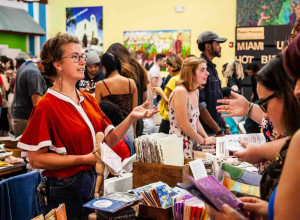
In New York's Jacob J. Javits Center during this year's Book Expo America (May 28-31), a senior editor waved her hand across nearby publishers' booths. "All this is a stage," she explained. "It may look like someone's over there cooking dinner, but it's a set, it's not real. Most business at BEA happens just by hanging out with your friends when they stop by your booth to chat, and at the parties." My first time at BEA, and I was desperate for a role.
In the Javits Center lobby, people with something to do and somewhere to go darted toward escalators and clustered near the press table. By contrast, I ambled along a massive grid of stalls and brightly colored poster-board, and before long had surrendered to snap judgments and superficiality. James Patterson: ubiquitous; Danielle Steele: coiffed; Wordsworth Classics edition of Rob Roy: worth every penny of its $4.99 cover price. I chatted aimlessly with librarians and marketing directors. But did I really need to know the "pub date" of James Elroy's new novel? Publishing insiders do not ask questions like a bored journalist. This wasn't going well.
Isn't book publishing becoming less about actual books and more about digital technologies? Here was conflict and an angle: I'd ingratiate myself by sympathizing with booksellers and producers and vilifying technologies that threaten their profits. "What's up with this Kindle thing?" I asked an unoccupied associate publisher. Her eyes lit up: "Ooh, have you used one? I think there's a display here. I've been dying to try it."
The publisher and I set off for the Amazon booth, though it wasn't clear whether we were looking to size up the competition or research Christmas gifts. In the literary technology section, we passed a Borders TV studio, were corralled into taking a touch-screen survey on why we were here, and then stumbled across two women serving piña coladas in perilously low-cut bathing suits. Turns out the beachwear and booze were a marketing Hail Mary for an e-reader called "The Cooler." A sales rep gave us a demonstration next to a kiddie pool full of sand. The Cooler looked like an iPod's creepy cousin and scrolled with the ease and readability of a stone tablet. No amount of rum was going to make this thing user-friendly.
The Cooler reps didn't seem like publishing insiders, and they didn't have much of a product, but they were having a good time. If I didn't have a part to play, I might as well enjoy being in the audience. Nearby, a small crowd gathered around a dark-haired boy of about thirteen. His eyes were glued to a monitor while his fingers flew across an approximation of an electric guitar. It was Danny Johnson, the Guinness World Record holder for Guitar Hero--a video game in which players follow along with pop songs on a plastic guitar. The booth's posters claimed Johnson would be trying for a different record, but his dad explained that "he already broke all the records," and was "just playing around now." Danny Johnson didn't crack a smile while he destroyed his competitions. Watching someone else playing video games is slightly more entertaining than watching my dog nap, so I moved on.
Guitar Hero and drinking before 2 p.m. are technically fun, but in a convention center recreation can feel a little too staged. The Independent Publishers Consortium (Consortium Book Sales), in a far corner of the fair, was loaded with small publishing houses handing out DVD catalogues, stickers and, at the Feral Books table, packets of opium seeds to help you "harvest your own pain medication." And it was here that I found the real headliners at BEA--the books, scads of them. And a chorus of representatives from participating independent publishers was more than happy to explain the plotline of a graphic novel by Mario Van Peebles or pass along a copy of Marilyn French's posthumously published novel The Love Children.
I'm not sure whether publishing is changing, or dying, or thriving (I'd seen plenty of evidence to support all three conclusions) but books are definitely myriad and exciting and people still write them, read them, and make them look good in a convention booth. I left with more than I could carry.
By Nicole Pasulka
In New York's Jacob J. Javits Center during this year's Book Expo America (May 28-31), a senior editor waved her hand across nearby publishers' booths. "All this is a stage," she explained. "It may look like someone's over there cooking dinner, but it's a set, it's not real. Most business at BEA happens just by hanging out with your friends when they stop by your booth to chat, and at the parties." My first time at BEA, and I was desperate for a role.
In the Javits Center lobby, people with something to do and somewhere to go darted toward escalators and clustered near the press table. By contrast, I ambled along a massive grid of stalls and brightly colored poster-board, and before long had surrendered to snap judgments and superficiality. James Patterson: ubiquitous; Danielle Steele: coiffed; Wordsworth Classics edition of Rob Roy: worth every penny of its $4.99 cover price. I chatted aimlessly with librarians and marketing directors. But did I really need to know the "pub date" of James Elroy's new novel? Publishing insiders do not ask questions like a bored journalist. This wasn't going well.
Isn't book publishing becoming less about actual books and more about digital technologies? Here was conflict and an angle: I'd ingratiate myself by sympathizing with booksellers and producers and vilifying technologies that threaten their profits. "What's up with this Kindle thing?" I asked an unoccupied associate publisher. Her eyes lit up: "Ooh, have you used one? I think there's a display here. I've been dying to try it."
The publisher and I set off for the Amazon booth, though it wasn't clear whether we were looking to size up the competition or research Christmas gifts. In the literary technology section, we passed a Borders TV studio, were corralled into taking a touch-screen survey on why we were here, and then stumbled across two women serving piña coladas in perilously low-cut bathing suits. Turns out the beachwear and booze were a marketing Hail Mary for an e-reader called "The Cooler." A sales rep gave us a demonstration next to a kiddie pool full of sand. The Cooler looked like an iPod's creepy cousin and scrolled with the ease and readability of a stone tablet. No amount of rum was going to make this thing user-friendly.
The Cooler reps didn't seem like publishing insiders, and they didn't have much of a product, but they were having a good time. If I didn't have a part to play, I might as well enjoy being in the audience. Nearby, a small crowd gathered around a dark-haired boy of about thirteen. His eyes were glued to a monitor while his fingers flew across an approximation of an electric guitar. It was Danny Johnson, the Guinness World Record holder for Guitar Hero--a video game in which players follow along with pop songs on a plastic guitar. The booth's posters claimed Johnson would be trying for a different record, but his dad explained that "he already broke all the records," and was "just playing around now." Danny Johnson didn't crack a smile while he destroyed his competitions. Watching someone else playing video games is slightly more entertaining than watching my dog nap, so I moved on.
Guitar Hero and drinking before 2 p.m. are technically fun, but in a convention center recreation can feel a little too staged. The Independent Publishers Consortium (Consortium Book Sales), in a far corner of the fair, was loaded with small publishing houses handing out DVD catalogues, stickers and, at the Feral Books table, packets of opium seeds to help you "harvest your own pain medication." And it was here that I found the real headliners at BEA--the books, scads of them. And a chorus of representatives from participating independent publishers was more than happy to explain the plotline of a graphic novel by Mario Van Peebles or pass along a copy of Marilyn French's posthumously published novel The Love Children.
I'm not sure whether publishing is changing, or dying, or thriving (I'd seen plenty of evidence to support all three conclusions) but books are definitely myriad and exciting and people still write them, read them, and make them look good in a convention booth. I left with more than I could carry.